
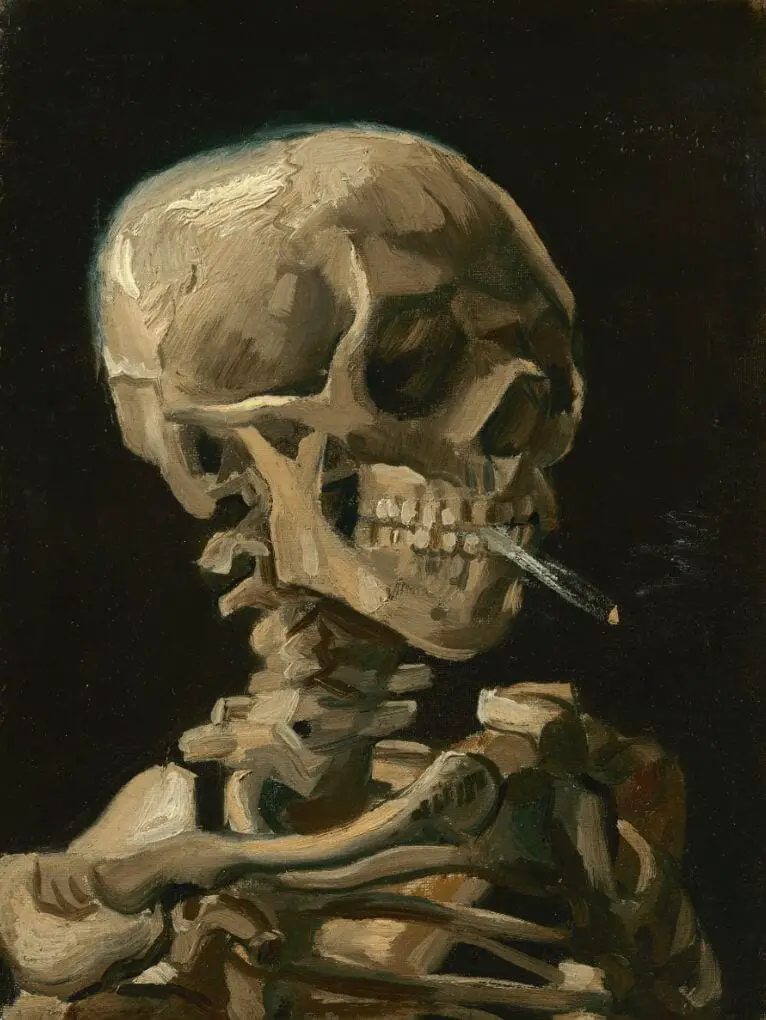
Why did Vincent van Gogh, a recognized master of color and profound psychological emotion, decide to paint a grinning skeleton clenching a burning cigarette between its exposed teeth? At first glance, Head of a Skeleton with a Burning Cigarette (1886) strikes the viewer not as a solemn masterwork of high art, but as a surprisingly modern piece of visual comedy.
It feels impossibly fresh, startlingly irreverent, and strikingly familiar to anyone raised on internet culture. This wasn’t merely a morbid joke or a dark daydream painted in a fit of isolated madness. It was a calculated, brilliant, and defiant middle finger aimed straight at the prestigious, suffocating art academies of the 1880s.
The Viral Skull and the Rebel Palette: How 19th-Century Painters Used Bone and Ash to Satirize the Elite
Today, as we look back across nearly a century and a half, Van Gogh’s smoking skeleton stands as the original 19th-century meme.
Long before digital screens, algorithmic trends, or viral social media posts, this small canvas captured a universal human impulse: using absurdity, dark humor, and shock tactics to mock an overbearing establishment. Today, we’re uncovering how late 19th-century painters weaponized bone, ash, and vice to satirize the rigid elite, reshaping visual culture forever.
I. The Viral Skull and the Rebel Palette and 19th-Century Painters
If you have spent any time scrolling through modern digital aesthetic feeds, vintage streetwear catalogs, or graphic design boards in recent years, chances are you have encountered Van Gogh’s skeletal smoker.
It appears on oversized canvas jackets, streetwear graphic tees, album covers, skateboards, and neon-lit digital avatars. In a world saturated with hyper-curated online personas and glossy digital perfection, the image resonates with a raw, effortless cool. It is the ultimate anti-aesthetic emblem: deadpan, morbid, casually burning through its own life force, yet utterly unbothered.
To understand why this specific image keeps resurfacing in modern visual culture, one must look at the psychological mechanics of viral imagery. The painting operates on a stark visual irony—a symbol of literal death participating in a mundane, leisurely human habit. It bridges the gap between high fine art and lowbrow street culture.
The thick, tactile brushstrokes and warm undertones give the bony skull an uncanny vitality, creating an aesthetic tension that modern designers constantly seek to replicate.
However, the roots of this viral icon were planted in the frantic, competitive atmosphere of late 19th-century Europe. By the mid-1880s, the Parisian and Antwerp art markets were increasingly overcrowded. Thousands of aspiring artists poured into European art capitals, each vying for space in the prestigious annual Salons, gallery windows, or private collections. The traditional avenues to artistic success were heavily guarded by conservative art academies that favored polished, classical, and noble subjects: mythical gods, heroic historical battles, and idealized aristocratic portraits.
In this hyper-saturated environment, artists quickly realized that technical competence alone was no longer enough to guarantee recognition. Shock tactics became a vital strategy for survival. By introducing unexpected, vulgar, or macabre elements into their work, rebellious painters could pierce through the sea of academic mediocrity, forcing both critics and the public to pay attention. Van Gogh’s skeletal smoker was born out of this volatile cultural boiling point—a tactical strike against artistic conformity.
II. 19th-Century Painters: A Middle Finger to the Academy
To fully grasp the rebellious bite of Van Gogh’s painting, one must step into the stifling environment of the 19th-century art academy. In the winter of 1885 to early 1886, Van Gogh attended the Royal Academy of Fine Arts in Antwerp, Belgium.
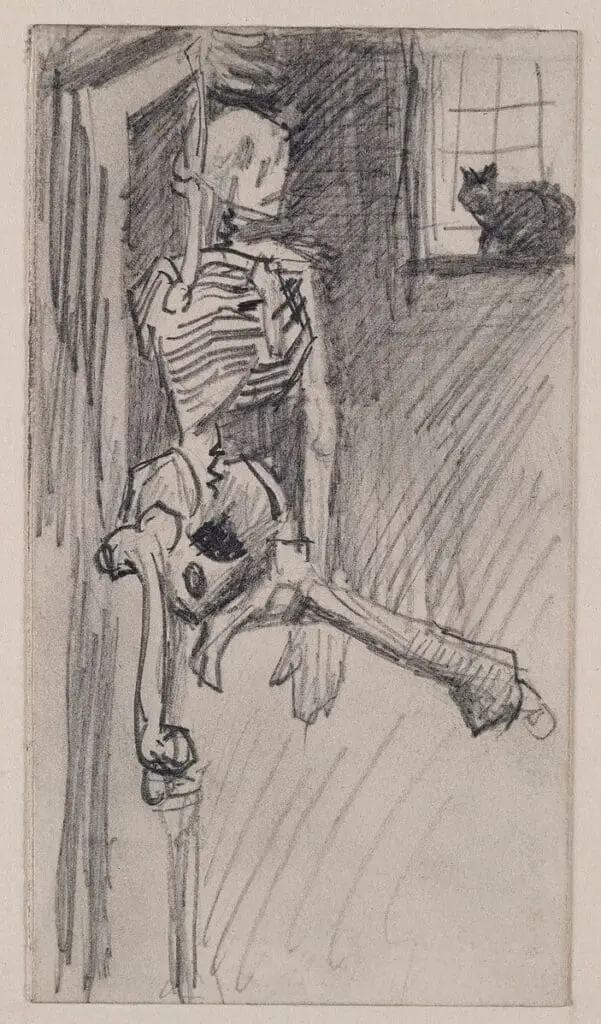
The pedagogical methods of these institutions were notoriously rigid, repetitive, and mind-numbingly conservative. Before students were ever allowed to paint a live human model—let alone experiment with personal expression—they were forced to spend endless months drawing from plaster casts and real human skeletons.
Day after day, under the watchful eye of stern professors, students meticulously sketched the exact proportions of bones, measuring light, shadow, and contour with mechanical precision. Anatomy was taught not as a dynamic foundation for human emotion, but as an exercise in cold, clinical discipline.
The goal was to train the artist’s hand to produce idealized, flawless anatomical forms that mirrored classical Greek and Roman statues. For an artist like Van Gogh, who viewed painting as a spiritual, raw, and intensely emotional language, these academic drills were akin to psychological torture.
“Academic drawing is a deceitful illusion; they teach us the dead shell of the human body while missing the pulsating spirit that burns within it.”
— Rebellious Sentiment of the Post-Impressionist Circle
Painting a burning cigarette sticking out of a skeleton’s jaw was an act of pure, unadulterated punk-rock vandalism directed at his stuffy academy professors. It was a direct mock-heroic parody of the dead anatomical studies he was forced to complete. By sticking a lit cigarette—a cheap, ubiquitous symbol of everyday working-class life—into the mouth of an academic teaching model,
Van Gogh effectively shattered the solemnity of the art classroom. It was the 19th-century visual equivalent of graffitiing a classical statue or laughing out loud during a dry academic lecture.
Moreover, the act of “lighting up” served a deeper creative function: it breathed life, motion, and dark humor into a static, dead subject. A skeleton is the ultimate symbol of permanent stillness. Yet, by adding the glowing ember of the cigarette and the faint curling wisps of smoke, Van Gogh reinfused the subject with a fleeting moment of human existence. The skeleton isn’t merely being studied; it is active, lounging, taking a smoke break from its own post-mortem existence. It transformed a lifeless studio prop into a character possessing attitude, personality, and a biting satirical voice.
III. 19th-Century Painters: The Modern Memento Mori
Van Gogh’s masterpiece did not exist in a vacuum; it represented a fundamental shift in how Western culture conceived of death. For centuries, European art had been dominated by the tradition of Memento Mori (Latin for “remember that you must die”) and Vanitas paintings. In the 16th and 17th centuries,
Dutch masters painted polished skulls placed alongside hourglasses, extinguished candles, decaying fruit, and dusty leather books. The moral message of these traditional works was clear, religious, and dogmatic: earthly pleasures, wealth, and physical beauty are temporary; turn your mind toward God and the salvation of your eternal soul before death inevitably claims you.
By the late 19th century, however, the Industrial Revolution had radically transformed the European landscape. Cities grew dense, smoky, and chaotic. Factories spewed soot into the air, steam engines roared through urban centers, and the pace of daily life accelerated at a breakneck speed. The spiritual certainty of the past was replaced by the harsh, industrial realities of modern life: factory labor, urban pollution, poverty, and chemical dependency.

Historical Pivot: The Evolution of the Memento Mori
- 17th Century (Traditional Vanitas): Religious, solemn, focused on divine judgment, divine fate, and the vanity of earthly wealth.
- 19th Century (Industrial Memento Mori): Secular, satirical, focused on urban habits, chemical vices, psychological fatigue, and existential absurdity.
In this soot-filled 19th-century reality, “vice” became the new lens through which people viewed their fleeting existence. Alcohol, absinthe, pipe tobacco, and the newly mass-produced cigarette became daily escapes from the grinding fatigue of industrial society. Death was no longer viewed primarily through the solemn terror of divine judgment; instead, it was tied directly to the physical habits, modern stresses, and self-destructive pleasures of urban life.
The 19th-century painter shifted from fearing God to mocking the physical toll of human habit. The skeleton in Van Gogh’s painting isn’t praying for salvation, nor is it warning the viewer to repent. It is actively participating in the very vice that accelerates its own demise. It reflects a modern, cynical self-awareness: a realization that human beings willingly consume substances that destroy them, finding solace in the brief satisfaction of a puff of smoke despite knowing the inevitable outcome.

IV. 19th-Century Painters: Smoking as a Psychological Signature
To fully appreciate the symbolic weight of the painting, one must examine the specific cultural power of the cigarette in the 1880s. During this era, tobacco consumption was undergoing a massive shift. The traditional, slow pipe was increasingly being replaced by the fast, cheap, mass-produced cigarette. Cigarettes became the ultimate physical emblem of the bohemian lifestyle—a signature accessory for poets, writers, radical thinkers, and impoverished studio artists who populated the cafes of Montmartre and Antwerp.
The cigarette was a badge of non-conformity. It signaled that one belonged to the avant-garde—a culture that rejected traditional bourgeois schedules, family structures, and respectable careers in favor of art, late-night philosophical debates, and existential freedom. To be a “tortured artist” was to be chained to one’s passions, consuming coffee and tobacco while burning through health in pursuit of creative truth.
Van Gogh himself was a chain smoker, famously relying on pipe tobacco and cigarettes to sustain himself during prolonged periods of intense work, often choosing tobacco over proper meals. In his personal letters to his brother Theo, Vincent frequently referred to tobacco as an essential coping mechanism for his nervous exhaustion, mental anguish, and isolation.
“Tobacco is the best medicine for the brain when it is overstrained by work… it lulls the mind into a quiet state while the hand continues to paint.”
— Vincent van Gogh (Adapted from Letters to Theo)
Seen through this lens, the skeletal smoker becomes a deeply personal psychological signature. It is a self-portrait of internal burnout. Skeletons in this era represented the internal exhaustion and acute anxiety of the pre-modern era—a time when rapid technological change, urban density, and spiritual doubt left creative minds feeling physically fragile and mentally drained.
There is a poignant, physical parallel between the medium of painting and the act of smoking. The physical ash created by the burning cigarette mirrors the pigment suspended on Van Gogh’s canvas. Just as the tobacco leaf burns down to grey ash, consumed by its own fire, the artist burns through his physical and mental vitality to produce art. It is a striking visual metaphor for the psychological cost of creation: the intense, self-consuming fire of trying to innovate in a world that refuses to understand you.
V. The Living Legacy of Macabre Satire
The lineage that connects Van Gogh’s skeletal smoker to contemporary visual culture is direct and unbroken. In the decades following Post-Impressionism, artists continued to turn to dark humor and macabre satire to express defiance against social norms and political absurdity. From the Dadaists responding to the horrors of World War I with collage-based grotesque figures, to the mid-century Lowbrow and Kustom Kulture artists who placed skulls on hot rods and comic covers, to the punk zines of the 1970s and 80s—the skull has remained the ultimate visual weapon of counter-culture rebellion.
In modern visual culture, this legacy thrives with fresh urgency. We live in an age that mirrors the late 19th century in striking ways: hyper-accelerated technology, intense social pressures, economic uncertainty, and widespread psychological burnout. It is hardly surprising that young creators, digital designers, and fashion brands repeatedly return to dark humor, skeletal motifs, and modern vice as a way to process the chaotic world around them.
Why do we still use skulls and substances to express our defiance? Because death remains the ultimate equalizer. When an artist clothes a skeleton in human vices—whether a cigarette, a leather jacket, or a pair of sunglasses—it instantly strip-mines authority figures, elite institutions, and societal expectations of their self-important power. It reminds us that underneath our resume, our status, our curated social media profiles, and our expensive clothes, we are all just bone and ash waiting to return to the earth.

The Ultimate Statement on Being Alive
When Vincent van Gogh placed that burning cigarette between the jaws of a studio skeleton in early 1886, he wasn’t romanticizing death—he was celebrating the absurd, defiant spark of life. By turning a clinical symbol of mortality into a laughing rebel, 19th-century artists proved that even in the face of inevitable decay, rigid social expectations, and institutional stuffiness, humor and creative rebellion will always have the final laugh. That grinning skeleton reminds us that to live fully is to refuse to take the establishment too seriously—to spark a light, defy the rules, and paint your own path, no matter how brief the burn may be.
Anita Louise Art is dedicated to art education, great artists, and inspiring others to find and create their art. We love art that uplifts and inspires. #ArtToMakeYouSmile! #ArtToMakeYouHappy!
If you want to see any of my art, you can find out more by clicking here. If you are interested in what inspires me and my paintings, you can discover more by clicking here.
We have a free newsletter and would love you to be part of our community; you can subscribe to the newsletter by clicking here. If you have any questions, I would be happy to talk to you anytime. You can reach me, Anita, by clicking here.
Subscribe to our Anita Louise Art YouTube Channel with great videos and information by clicking here.
Join us for our podcast “5 Minutes With Art or Deep Dive with 5 Minutes With Art” Spend just a few minutes a week with us to discover and learn about great art and artists. You can find out more about our podcast by clicking here.
Related Questions
The Myth of the Tortured Artist: Is Suffering the Secret Ingredient to Greatness?
There is a persistent, almost seductive belief in the art world: that to create truly profound work, an artist must first be broken. We have romanticized the “starving artist” and the “mad genius” to the point where we sometimes wonder if stability is the enemy of creativity. But is this true? Is suffering actually a prerequisite for greatness, or is the “Tortured Artist” a myth that does more harm than good?
The Myth of the Tortured Artist: Is Suffering the Secret Ingredient to Greatness? Click here to learn more.
Van Gogh Color Symbolism: The Secret Language of Yellow and Blue and What It Reveals About the Human Soul
If you were to close your eyes and think of the name “Vincent van Gogh,” what do you see? Chances are, it isn’t just a face with a red beard. It’s a vivid display of Van Gogh Color Symbolism—a collision of colors that define his art: the searing, almost blinding yellow of a sunflower set against a swirling, deep-midnight blue. These iconic hues are more than aesthetic choices; they embody the emotional depth and creative vision that make Van Gogh’s work so unforgettable.
Van Gogh Color Symbolism: The Secret Language of Yellow and Blue and What It Reveals About the Human Soul Click here to discover more