

Check out the art of chiaroscuro if you want to understand the profound shift between the balanced perfection of the Renaissance and the emotional explosion of the Baroque era. Specifically, the pitch-black, engulfing shadows painted by Michelangelo Merisi da Caravaggio.
Caravaggio did not just paint with color; he painted with darkness. Operating at the turn of the 17th century, this volatile, brawling, and brilliant Italian artist completely upended the art world. He abandoned the serene, evenly lit landscapes of his predecessors and dragged his subjects into a gritty, theatrical spotlight. Read on we are going to explore how Caravaggio’s revolutionary lighting techniques—specifically chiaroscuro and tenebrism—changed art forever, take a deep dive into his undisputed masterpiece, The Calling of St. Matthew, and uncover exactly why he remains one of the most influential painters in history.

Decoding Chiaroscuro: The Shock of the Shadow
To appreciate Caravaggio’s genius, we first have to understand the tools of his trade. Chiaroscuro is an Italian term that translates literally to “light-dark.” It refers to the use of strong contrasts between illumination and shadow to achieve a sense of volume in modeling three-dimensional objects and figures.
While Renaissance masters like Leonardo da Vinci utilized chiaroscuro to give a soft, realistic roundness to human faces (think of the subtle shading on the Mona Lisa), Caravaggio took the concept and weaponized it. He pushed chiaroscuro to such an extreme that art historians gave it a new name: tenebrism (from the Italian tenebroso, meaning dark, gloomy, or mysterious).
In Caravaggio’s era, this was an astonishing, almost radical way to paint. Here is why it was so unique:
| Feature | High Renaissance Tradition | Caravaggio’s Tenebrism |
| Lighting | Even, balanced, mimicking daylight | A single, harsh, artificial spotlight |
| Backgrounds | Detailed landscapes or deep architectural vistas | Pitch-black voids that swallow the background |
| Figures | Idealized, god-like, mathematically perfect | Gritty realism, painted directly from life |
| Atmosphere | Harmonious, intellectual, serene | Tense, theatrical, psychologically gripping |
By plunging his backgrounds into absolute darkness, Caravaggio forced the viewer’s eye exactly where he wanted it. The darkness stripped away any distracting details. You weren’t looking at a sprawling hillside or a beautiful Roman sky; you were locked into an intense, intimate moment of human drama. The light in his paintings doesn’t just illuminate the scene; it acts as a character in its own right—often representing divine grace slicing through the darkness of the mortal world.
Chiaroscuro – A Masterclass in Light: The Calling of St. Matthew
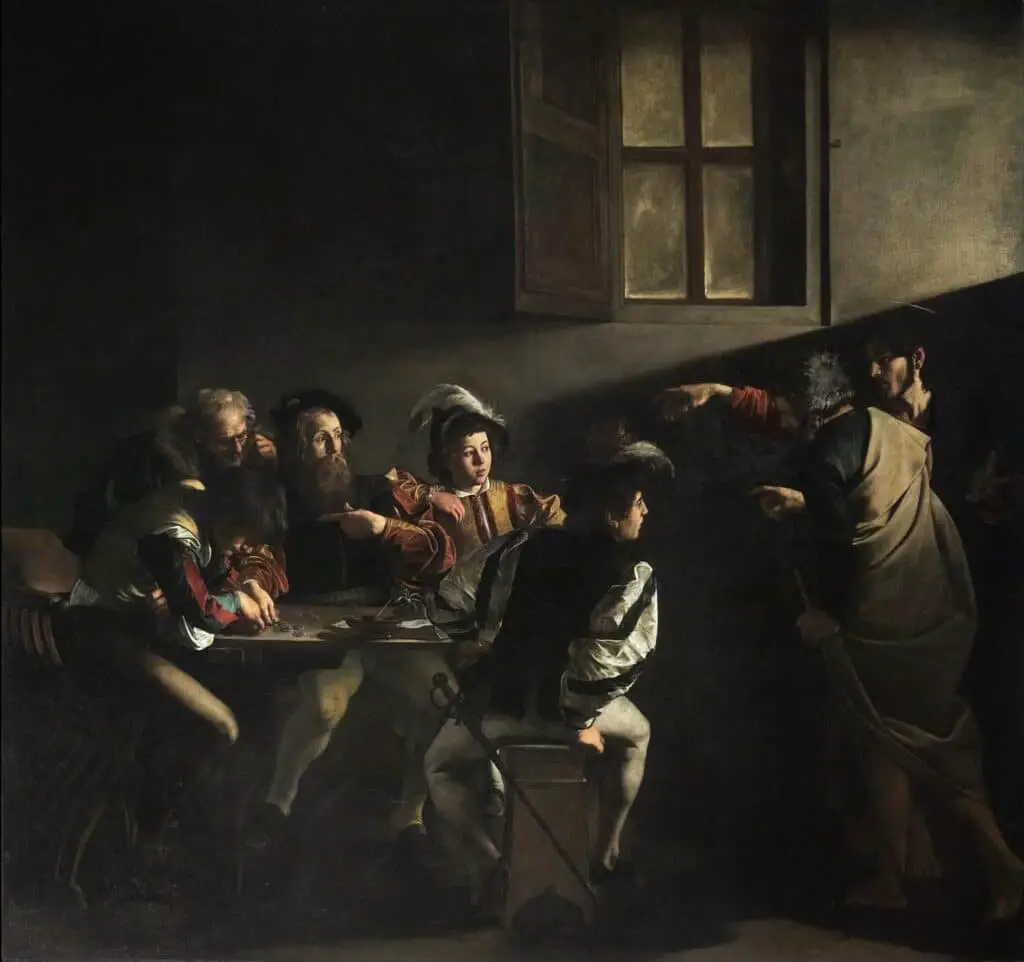
Nowhere is Caravaggio’s mastery of light more powerful than in his breakout public commission: The Calling of St. Matthew (1599–1600). Housed in the Contarelli Chapel of San Luigi dei Francesi in Rome, this massive oil painting captures the exact moment Jesus Christ asks Matthew, a corrupt tax collector, to abandon his worldly life and become an apostle.
Take a moment to truly look at the composition. The scene takes place not in a holy temple, but in a dingy, shadow-filled tavern. On the left, Matthew and his associates are huddled around a table, counting coins. They are dressed in contemporary 17th-century fashion—velvets, plumed hats, and doublets. This was Caravaggio’s way of making the biblical scene relatable to the people of his day.
Then, from the right, Christ enters with St. Peter. But Christ is almost entirely swallowed by the shadows. What truly enters the room is the light.
Key insight: The stark, diagonal beam of light that slices across the upper right of the canvas is the true protagonist of the painting. It follows the gesture of Christ’s pointing hand, acting as a physical manifestation of divine calling. It cuts through the gloom of the tavern, striking the faces of the men at the table and illuminating Matthew’s shocked expression as he points to himself, as if to say, “Who, me?”
The Genius of the Details.
- The Light Source: The painted light source perfectly matches the actual, physical window in the Contarelli Chapel. When you stand in the chapel, it appears as though the real light of the church is spilling directly into Caravaggio’s canvas.
- The Pointing Hand: Look closely at Christ’s hand. The limp, relaxed wrist is a direct visual quote of Adam’s hand in Michelangelo’s The Creation of Adam on the Sistine Chapel ceiling. By mirroring this famous gesture, Caravaggio subtly communicates that Christ is the “New Adam,” bringing a second creation and spiritual rebirth to Matthew.
- The Division of Worlds: The light splits the painting in two. The right side, containing Jesus and Peter, represents the divine and the eternal. The left side, focused on the table and the money, represents the earthly, sinful, and temporal. The beam of light is the bridge between them.
The Gritty Reality of the Divine
Another reason Caravaggio is considered one of the greatest painters in Western art is his unyielding commitment to realism. The Church during the Counter-Reformation wanted art that inspired piety and awe. They wanted heavenly figures to look heavenly.
Caravaggio refused.
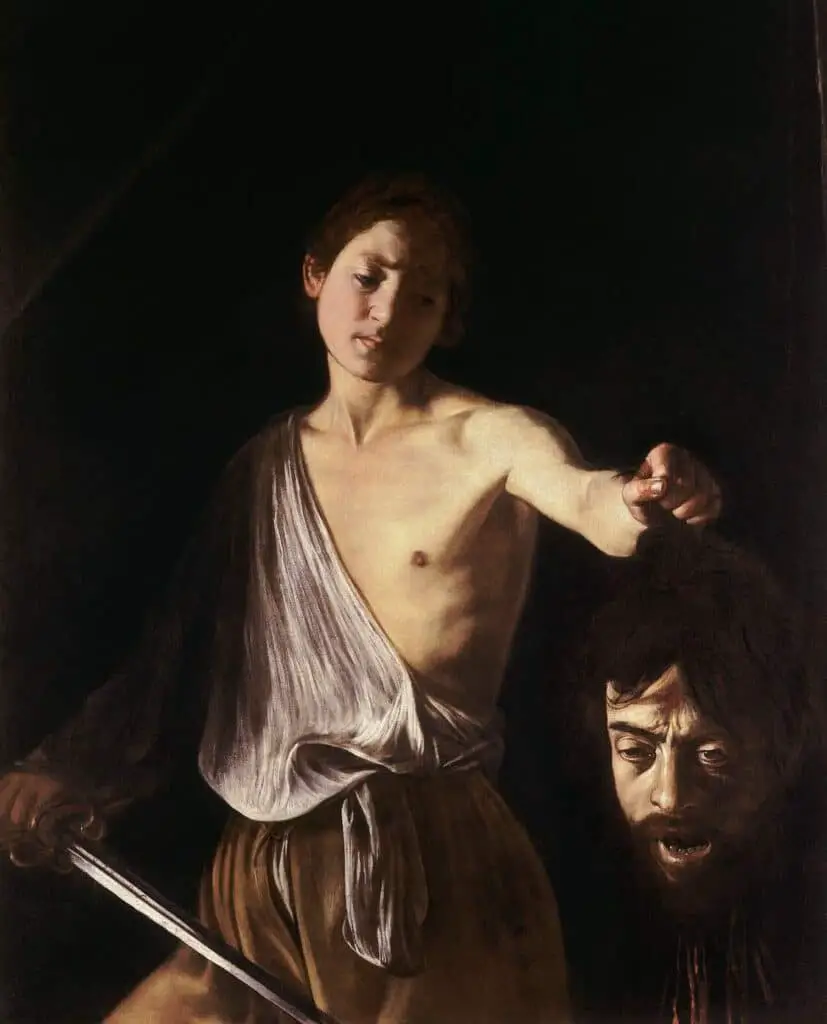
He famously pulled his models straight from the streets of Rome. He used brawlers, beggars, and prostitutes to model for saints, apostles, and the Virgin Mary. He painted them with dirty fingernails, wrinkled brows, and calloused, sun-baked feet.
In paintings like Judith Beheading Holofernes, you can see how his extreme lighting elevates this gritty realism into high tragedy. The pitch-black background pushes the violence and the psychological horror right to the front of the picture plane. The light doesn’t flatter the subjects; it exposes them. It catches the spray of blood, the grimace of effort on Judith’s face, and the sheer terror of Holofernes.
This combination of intense, cinematic lighting and hyper-realistic, everyday models made biblical stories feel immediate and urgently real. Caravaggio proved that the divine didn’t just exist in the clouds—it could be found in the darkest, dirtiest taverns and alleyways of the real world.
The Legacy of the Shadows
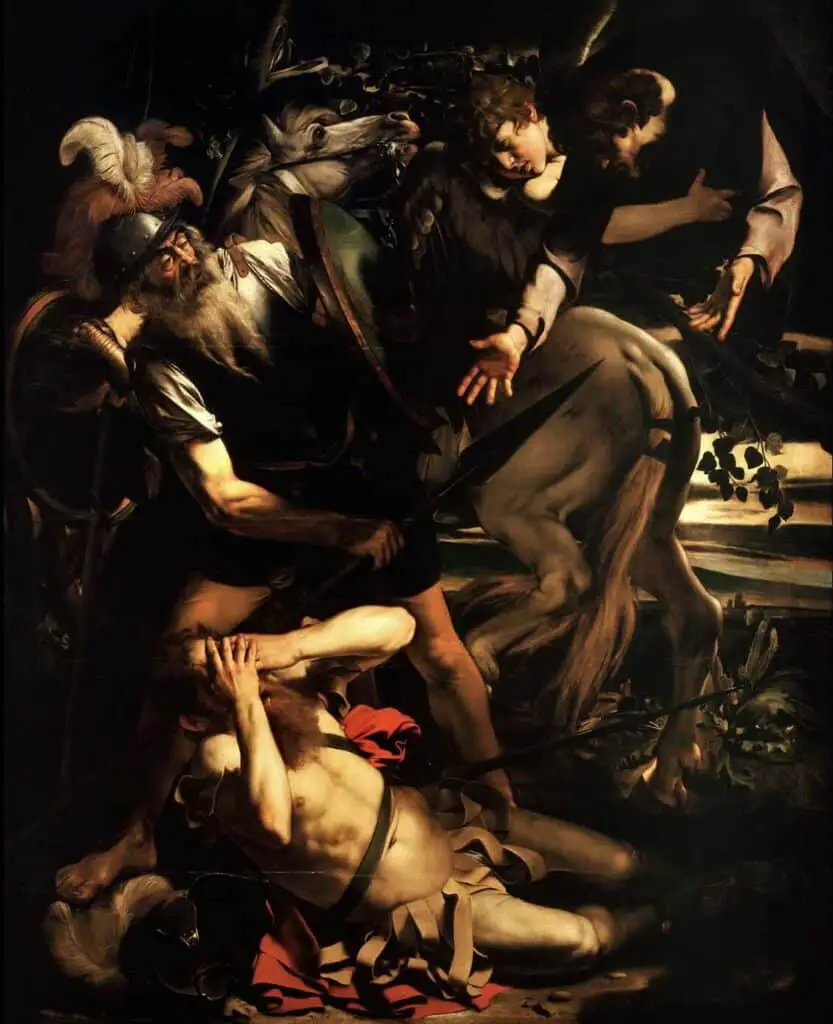
Caravaggio’s career was as short and violent as the scenes he painted. He had to flee Rome in 1606 after killing a man in a sword fight, and he died in exile just four years later at the age of 38.
Yet, his impact was instantaneous and global. He spawned an entire generation of followers known as the Caravaggisti, who eagerly adopted his extreme chiaroscuro. Without Caravaggio, there is no Baroque art as we know it. The psychological depth of Rembrandt, the theatrical grandeur of Peter Paul Rubens, the stark realism of Diego Velázquez, and the feminist vengeance in the works of Artemisia Gentileschi all owe a massive debt to the rebellious Italian who dared to turn off the lights.
Caravaggio remains one of the great painters because he understood a fundamental truth about human nature and visual storytelling: to make the light truly matter, you must first master the darkness. His paintings do not just sit passively on a wall; they reach out of the shadows, grab you by the collar, and pull you right into the drama.

Check Out Our Video
Watch our video on Decoding the Shadows – Caravaggio: The Master of Light and Shadow
Anita Louise Art is dedicated to art education, great artists, and inspiring others to find and create their art. We love art that uplifts and inspires. #ArtToMakeYouSmile! #ArtToMakeYouHappy!
If you want to see any of my art, you can find out more by clicking here. If you are interested in what inspires me and my paintings, you can discover more by clicking here.
We have a free newsletter and would love you to be part of our community; you can subscribe to the newsletter by clicking here. If you have any questions, I would be happy to talk to you anytime. You can reach me, Anita, by clicking here.
Subscribe to our Anita Louise Art YouTube Channel with great videos and information by clicking here.
Join us for our podcast “5 Minutes With Art or Deep Dive with 5 Minutes With Art” Spend just a few minutes a week with us to discover and learn about great art and artists. You can find out more about our podcast by clicking here.
Related Questions
The Myth of the Tortured Artist: Is Suffering the Secret Ingredient to Greatness?
There is a persistent, almost seductive belief in the art world: that to create truly profound work, an artist must first be broken. We have romanticized the “starving artist” and the “mad genius” to the point where we sometimes wonder if stability is the enemy of creativity. But is this true? Is suffering actually a prerequisite for greatness, or is the “Tortured Artist” a myth that does more harm than good?
The Myth of the Tortured Artist: Is Suffering the Secret Ingredient to Greatness? Click here to learn more.
Van Gogh Color Symbolism: The Secret Language of Yellow and Blue and What It Reveals About the Human Soul
If you were to close your eyes and think of the name “Vincent van Gogh,” what do you see? Chances are, it isn’t just a face with a red beard. It’s a vivid display of Van Gogh Color Symbolism—a collision of colors that define his art: the searing, almost blinding yellow of a sunflower set against a swirling, deep-midnight blue. These iconic hues are more than aesthetic choices; they embody the emotional depth and creative vision that make Van Gogh’s work so unforgettable.
Van Gogh Color Symbolism: The Secret Language of Yellow and Blue and What It Reveals About the Human Soul Click here to discover more.
Katsushika Hokusai: The “Old Man Mad About Drawing” Who Changed the World
We often think of “influencers” as a modern phenomenon, but Katsushika Hokusai proves that true influence transcends time and technology. In the 19th century, Katsushika Hokusai was the biggest influencer in the art world—not with a smartphone, but with a woodblock, a bowl of Prussian Blue ink, and a spiritual obsession with a mountain. His groundbreaking work continues to inspire artists and admirers around the globe.