

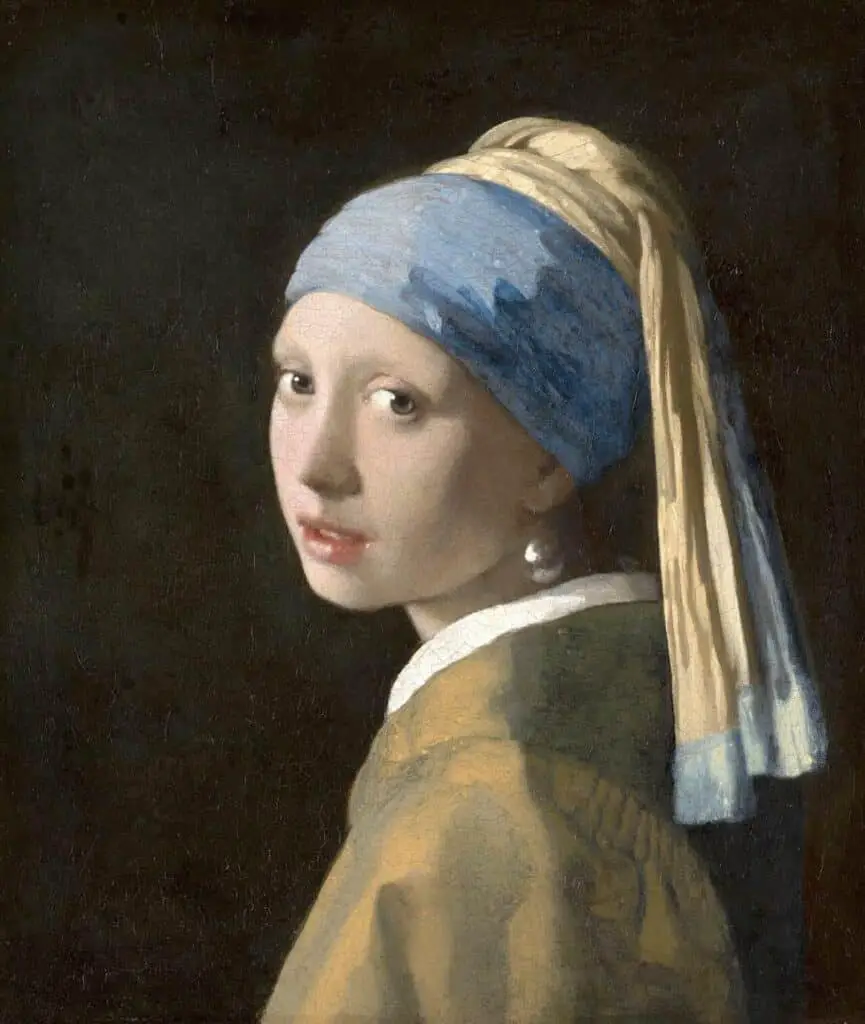
Girl with a Pearl Earring is one of those rare masterpieces that seems to transcend time, captivating viewers with its delicate beauty and enigmatic allure. Often referred to as the “Mona Lisa of the North,” this painting by Johannes Vermeer is not only his most famous work but also one of the most iconic images in art history.
For me personally, Girl with a Pearl Earring has always held a special place in my heart. Its mysterious gaze, soft light, and compelling story continue to draw me in, making it a painting I return to again and again. Read on as I unravel the mystery behind Vermeer’s Girl with a Pearl Earring. We’ll explore its history, the stories behind the painting, its enduring significance, and what makes it so special—even today.

The Artist: Johannes Vermeer, The Sphinx of Delft
Before diving into the painting itself, it’s important to understand the artist behind the masterpiece. Johannes Vermeer was born in Delft, Netherlands, in 1632. He lived his entire life in this small Dutch city, and his legacy is shrouded in mystery.
Very little is known about Vermeer’s personal life, earning him the nickname “The Sphinx of Delft.” Unlike many artists of his time, Vermeer did not leave behind letters, diaries, or detailed records. Instead, his paintings are the primary source we have for understanding his genius.
Vermeer was not prolific; only around 36 paintings are attributed to him. Yet, each work is a testament to his extraordinary skill with light, color, and composition. His ability to capture quiet moments and subtle expressions is unmatched. Vermeer’s subjects were often women, painted in domestic settings, engaged in everyday tasks. His works are celebrated for their tranquility, intimacy, and technical brilliance.
Girl with a Pearl Earring: A Brief History
Girl with a Pearl Earring was painted around 1665, during the Dutch Golden Age. At this time, the Netherlands was a hub of artistic innovation, and Vermeer was among its most talented painters.
The painting is not a portrait in the traditional sense but a “tronie”—a study of a character or type rather than a specific individual. Tronies were popular in the 17th century, allowing artists to experiment with facial expressions, costumes, and lighting.
Interestingly, the painting was not always known as Girl with a Pearl Earring. Until 1995, it was called Girl with Turban, referencing the exotic headwear the girl dons.
The turban is not typical for Dutch women of that era; instead, it hints at the fascination with the Orient and the wider world beyond Europe. In 1995, the painting was renamed to highlight the gleaming earring, which draws the viewer’s eye and adds a sense of luxury and mystery.
However, in 2014, researchers discovered that the earring is not actually a pearl. Instead, it is believed to be a glass, lacquered drop earring. The way it reflects light is inconsistent with how pearls usually appear. Despite this revelation, the painting retains its famous name, a testament to the power of perception and the allure of mystery.

The Model: Who Is the Girl with a Pearl Earring?
One of the most compelling aspects of Girl with a Pearl Earring is the identity of the girl. Unlike many portraits, this is not a depiction of a well-known figure. As a tronie, the painting is meant to represent a type rather than a person.
Still, speculation abounds. Some art historians believe the model may have been Vermeer’s eldest daughter, Maria, who would have been around thirteen when the painting was created. However, there is no concrete evidence to support this theory.
The lack of information about the girl’s identity only adds to the painting’s mystique. Her gaze is direct yet gentle, her lips slightly parted as if about to speak.
The ambiguity of her identity has led to comparisons with Leonardo da Vinci’s Mona Lisa, another enigmatic portrait. While there are clues about who the Mona Lisa may be, the girl in Vermeer’s painting remains a mystery, inviting endless interpretation and fascination.
The Ownership Of Girl with a Pearl Earring: A Journey Through Time
After Vermeer’s death in 1675, Girl with a Pearl Earring passed through several hands. It is believed that Pieter van Ruiven, a wealthy art collector and supporter of Vermeer, acquired the painting. Van Ruiven’s patronage was crucial to Vermeer’s career, and he owned many of the artist’s works. After van Ruiven’s death, the painting changed owners multiple times before being auctioned in The Hague in 1881.
At this auction, Girl with a Pearl Earring was almost lost to history. The catalog listed the painter as “unknown,” but Victor de Stuers, a government official for the arts, recognized its significance. De Stuers and his neighbor, art dealer Arnoldus Andries des Tombe, agreed not to bid against each other.
Des Tombe purchased the painting for just two guilders and thirty cents—a shocking bargain for what would become a world-famous masterpiece. After Des Tombe’s death in 1902, he bequeathed the painting to the Mauritshuis museum in The Hague, where it remains today.

The Beauty and Technique: Why I Love Girl with a Pearl Earring?
There’s something magical about Girl with a Pearl Earring that goes beyond its historical significance or mysterious backstory. For me, the painting’s beauty lies in its simplicity and intimacy.
Vermeer’s use of light is extraordinary; the girl’s face glows against the dark background, her features rendered with exquisite delicacy. The soft folds of her turban, the glimmer of the earring, and the gentle curve of her lips all contribute to a sense of quiet elegance.
The painting is also a masterclass in color and composition. Vermeer’s palette is restrained yet vibrant, with the deep blues and yellows of the turban contrasting beautifully with the girl’s pale skin.
The background is almost black, drawing the viewer’s attention directly to the subject. Every brushstroke is purposeful, creating a sense of depth and realism that feels almost photographic.
What I find most captivating is the girl’s expression. She seems to exist in a moment of transition, caught between thought and speech, presence and absence. Her gaze is both direct and elusive, inviting the viewer into her world while keeping her secrets intact. This ambiguity is what makes the painting so powerful—it leaves space for interpretation, allowing each viewer to find their own meaning.
The Mystery: The “Mona Lisa of the North” Girl with a Pearl Earring
The nickname “Mona Lisa of the North” is well-deserved. Like da Vinci’s masterpiece, Girl with a Pearl Earring is defined by its mystery. The identity of the girl, the nature of the earring, and even the story of the painting’s ownership are all shrouded in uncertainty. This sense of mystery is part of what makes the painting so iconic.
But the mystery is not just about unanswered questions—it’s about the feeling the painting evokes. There’s a sense of intimacy and immediacy, as if the girl is about to step out of the frame and into our world. The painting captures a fleeting moment, a glimpse of life that is both universal and deeply personal.
This quality has inspired countless interpretations, novels, films, and scholarly debates. Tracy Chevalier’s novel Girl with a Pearl Earring and the subsequent film adaptation brought the painting to a new audience, imagining the story behind the enigmatic girl. Yet, even as new theories and stories emerge, the painting retains its sense of mystery, refusing to give up its secrets.
The Enduring Icon: Why Girl with a Pearl Earring Remains Relevant
So why does Girl with a Pearl Earring continue to captivate audiences centuries after it was painted? I believe it’s a combination of beauty, mystery, and universality.
The painting is a testament to Vermeer’s skill as an artist, but it’s also a reflection of the human experience. The girl’s expression, her gaze, and the play of light and shadow all evoke emotions that are timeless.
In a world that is constantly changing, Girl with a Pearl Earring offers a moment of stillness. It invites us to pause, to look closely, and to appreciate the subtleties of life. The painting’s simplicity is deceptive; beneath the surface lies a wealth of complexity and meaning.
Moreover, the painting’s story is one of resilience. It survived centuries of obscurity, changing hands and names, almost lost to history. Today, it is celebrated as one of the greatest masterpieces of the Dutch Golden Age, a symbol of beauty and mystery.

Personal Reflections: Why The Girl with a Pearl EarringMatters to Me
As someone who loves art, Girl with a Pearl Earring has always been one of my favorites. There’s a quiet power in the painting that speaks to me. I am drawn to the girl’s gaze, the softness of her features, and the richness of her surroundings.
Each time I see the painting, I notice something new—a subtle shift in light, a hint of emotion, a detail in the turban or earring.
The painting reminds me of the importance of looking closely, of appreciating the details that make life beautiful. It’s a reminder that mystery can be a source of inspiration, that not everything needs to be explained or understood. Sometimes, the most powerful art is the one that leaves us with questions, inviting us to explore and imagine.
Unraveling the Mystery Of The Girl with a Pearl Earring
Girl with a Pearl Earring is more than just a painting—it’s a story, a mystery, and a work of art that continues to inspire. From its origins as a tronie to its journey through history, the painting has captured the imagination of viewers around the world. Its beauty lies in its simplicity, its mystery in its ambiguity, and its power in its ability to evoke emotion.
Johannes Vermeer’s masterpiece reminds us that art is not just about answers—it’s about questions, exploration, and the joy of discovery. Whether you’re an art lover or simply someone who appreciates beauty, Girl with a Pearl Earring offers a glimpse into the heart of creativity and the enduring power of mystery.
If you haven’t seen the painting in person, I highly recommend visiting the Mauritshuis in The Hague. Standing before the original, you’ll understand why this painting continues to captivate, inspire, and enchant—centuries after it was created.
Girl with a Pearl Earring is, and will always be, a painting that invites us to look, wonder, and dream. It’s a favorite of mine, not just for its beauty, but for the endless stories it inspires.

Other Johannes Vermeer’s Content And The Girl with a Pearl Earring
Read some other related content on my blog, where I delve into Girl with a Pearl Earring as well as other captivating works by Johannes Vermeer.
His paintings, renowned for their exquisite use of light and intimate scenes, provide a glimpse into everyday life during the Dutch Golden Age. While Girl with a Pearl Earring stands out as a personal favorite for its mystery and beauty, Vermeer’s broader body of work continues to inspire and fascinate, deepening our appreciation of art and history.
- Unveiling the Mystique: A Deep Dive into Johannes Vermeer’s Art Read our blog by clicking here.
- The Enigmatic Brilliance Of Johannes Vermeer’s Paintings Read our blog by clicking here.
- Are There Any Known Living Direct Descendants Of Johannes Vermeer? Discover more by clicking here.
- How Much Is Johannes Vermeer’s Girl With A Pearl Earring Worth? Learn more by clicking here.
Deep Dive Podcast About Unveiling the Mystery: Girl with a Pearl Earring and the Secrets of Vermeer
Listen to our Deep Dive podcast about Unveiling the Mystery: Girl with a Pearl Earring and the Secrets of Vermeer.
Anita Louise Art is dedicated to art education, great artists, and inspiring others to find and create their art. We love art that uplifts and inspires. #ArtToMakeYouSmile! #ArtToMakeYouHappy!
If you want to see any of my art, you can find out more by clicking here. If you are interested in what inspires me and my paintings, you can discover more by clicking here.
We have a free newsletter and would love you to be part of our community; you can subscribe to the newsletter by clicking here. If you have any questions, I would be happy to talk to you anytime. You can reach me, Anita, by clicking here.
Subscribe to our Anita Louise Art YouTube Channel with great videos and information by clicking here.
Join us for our podcast “5 Minutes With Art or Deep Dive with 5 Minutes With Art” Spend just a few minutes a week with us to discover and learn about great art and artists. You can find out more about our podcast by clicking here.
Related Questions
The Myth of the Tortured Artist: Is Suffering the Secret Ingredient to Greatness?
There is a persistent, almost seductive belief in the art world: that to create truly profound work, an artist must first be broken. We have romanticized the “starving artist” and the “mad genius” to the point where we sometimes wonder if stability is the enemy of creativity. But is this true? Is suffering actually a prerequisite for greatness, or is the “Tortured Artist” a myth that does more harm than good?
The Myth of the Tortured Artist: Is Suffering the Secret Ingredient to Greatness? Click here to learn more.
Van Gogh Color Symbolism: The Secret Language of Yellow and Blue and What It Reveals About the Human Soul
If you were to close your eyes and think of the name “Vincent van Gogh,” what do you see? Chances are, it isn’t just a face with a red beard. It’s a vivid display of Van Gogh Color Symbolism—a collision of colors that define his art: the searing, almost blinding yellow of a sunflower set against a swirling, deep-midnight blue. These iconic hues are more than aesthetic choices; they embody the emotional depth and creative vision that make Van Gogh’s work so unforgettable.
Van Gogh Color Symbolism: The Secret Language of Yellow and Blue and What It Reveals About the Human Soul Click here to discover more.
Katsushika Hokusai: The “Old Man Mad About Drawing” Who Changed the World
We often think of “influencers” as a modern phenomenon, but Katsushika Hokusai proves that true influence transcends time and technology. In the 19th century, Katsushika Hokusai was the biggest influencer in the art world—not with a smartphone, but with a woodblock, a bowl of Prussian Blue ink, and a spiritual obsession with a mountain. His groundbreaking work continues to inspire artists and admirers around the globe.