

Few paintings in the history of Western art have captivated audiences quite like Rembrandt’s The Night Watch. Created in 1642, this monumental canvas embodies the spirit of the Baroque era, with its dynamic composition, dramatic lighting, and enigmatic storytelling. The Night Watch is not only a technical marvel but also a cultural icon, reflecting the artistic genius of Rembrandt and the vibrant society of 17th-century Amsterdam.
Read on as we will unpack the details and significance of Rembrandt’s The Night Watch. We’ll explore its innovative composition, the use of light and shadow, the mystery surrounding its creation, and why it remains one of the most celebrated masterpieces in art history.

Rembrandt: The Artist and His Era
The Life of Rembrandt van Rijn
Rembrandt Harmenszoon van Rijn was born in 1606 in Leiden, Netherlands. He showed artistic promise early and began his studies at the University of Leiden before apprenticing with local painters. By his twenties, Rembrandt had established himself in Amsterdam, quickly gaining fame for his portraiture, historical scenes, and ability to capture the human soul.
Rembrandt’s career was marked by both tremendous success and personal tragedy. He enjoyed patronage from wealthy clients and civic organizations but faced financial hardship and the loss of loved ones. Despite these challenges, his output remained prolific, and his style evolved to embrace the emotional depth and complexity that define his mature works.
The Baroque Context
The Baroque period, spanning the 17th century, was characterized by grandeur, movement, and intense emotion. Artists sought to engage viewers with dramatic scenes, rich color palettes, and dynamic compositions. Rembrandt, often considered the greatest Dutch Baroque painter, brought these qualities to new heights, infusing his works with psychological insight and technical innovation.
Rembrandt’s The Night Watch: An Overview
Rembrandt’s The Night Watch: Commission and Purpose
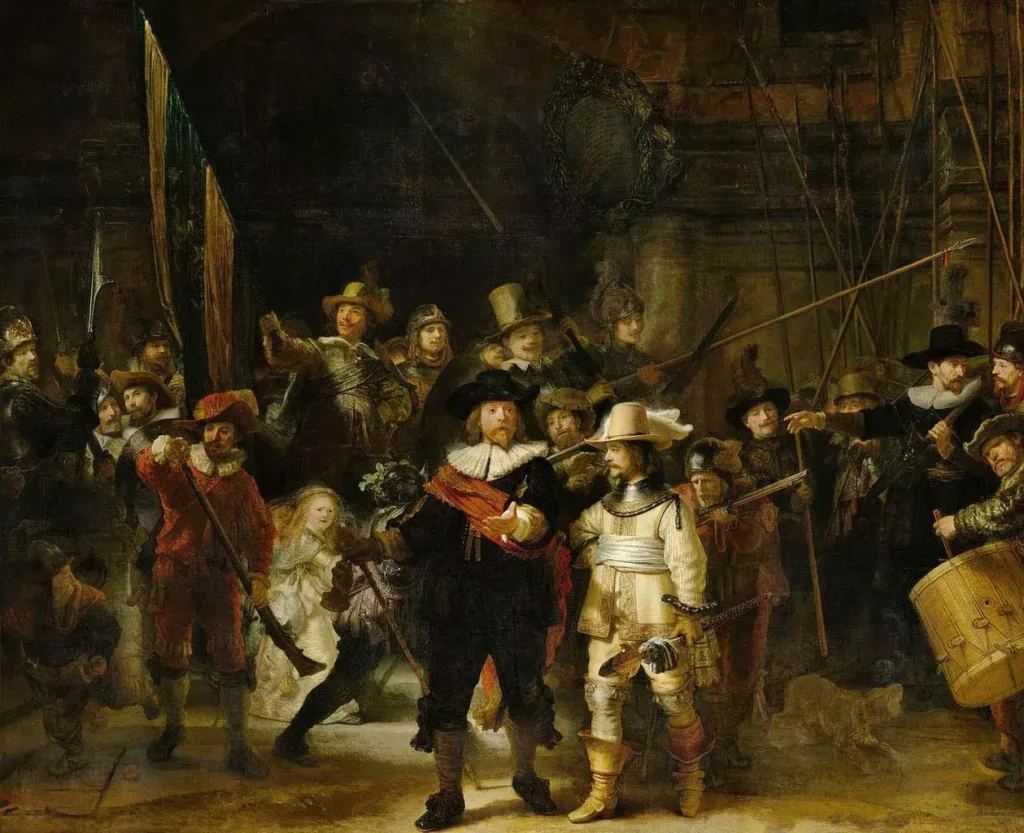
The Night Watch, officially titled “Militia Company of District II under the Command of Captain Frans Banninck Cocq,” was commissioned by the Amsterdam civic militia. Such groups were responsible for defending the city and maintaining order, and it was customary for them to commission group portraits to commemorate their service.
Unlike the static, formal arrangements typical of militia portraits, Rembrandt’s painting is a vibrant narrative. He transforms a collective portrait into a scene of action and drama, elevating it to the realm of history painting.
Size and Impact
The Night Watch is enormous, measuring over 14 feet wide and nearly 12 feet tall. Its scale was intended to impress and assert the importance of the militia. Today, it dominates the Rijksmuseum in Amsterdam, drawing millions of visitors who marvel at its power and complexity.

Rembrandt’s The Night Watch: Innovative Composition
Breaking Tradition
Prior to The Night Watch, group portraits were usually stiff and orderly, with members lined up in rows. Rembrandt shattered this convention, creating a composition that feels alive and spontaneous. The figures are arranged in a diagonal, with Captain Cocq and his lieutenant, Willem van Ruytenburch, at the center, leading the company forward.
The painting captures the moment the militia prepares to march out, with members loading muskets, adjusting uniforms, and interacting with one another. This sense of movement and activity gives The Night Watch its unique vitality.
Depth and Perspective
Rembrandt uses perspective and overlapping figures to create depth, drawing the viewer into the scene. The placement of characters, the gestures, and the interplay of gazes guide the eye across the canvas. The diagonal composition, combined with the dramatic lighting, enhances the sense of action and urgency.
The Characters
The painting includes 34 figures, each rendered with individual personality and detail. Rembrandt’s skill in portraiture is evident in the lifelike expressions and subtle interactions. The central figures—Captain Cocq dressed in black with a red sash, and Lieutenant Ruytenburch in yellow—are illuminated and command attention, while others fade into shadow or emerge from the background.
Among the crowd is a mysterious girl, often referred to as the mascot of the militia. Her presence adds intrigue, and her brightly lit figure contrasts with the darker tones of the painting, inviting speculation about her symbolic role.

Rembrandt’s The Night Watch: Dramatic Lighting: Chiaroscuro at Its Finest
The Power of Light and Shadow
One of Rembrandt’s greatest innovations in The Night Watch is his use of chiaroscuro—the contrast between light and dark. This technique, perfected by Baroque artists, creates drama and focus, highlighting key figures and actions while plunging others into shadow.
Rembrandt’s mastery of lighting draws the viewer’s eye to Captain Cocq and Lieutenant Ruytenburch, whose faces and clothing shine with golden light. The surrounding figures are enveloped in a play of shadows, creating a sense of mystery and depth.
Symbolism and Mood
The interplay of light and darkness in The Night Watch is not merely technical; it serves to convey mood and meaning. The illuminated figures represent leadership and action, while the shadows hint at the unknown and the complexity of the group. This use of lighting underscores the painting’s narrative, emphasizing the tension and anticipation of the moment.
Realism and Atmosphere
Rembrandt’s ability to render textures and surfaces with light is unparalleled. The glint of metal, the softness of feathers, and the sheen of fabric are all brought to life through his brushwork. The atmospheric quality of the painting immerses viewers, making them feel as though they are witnessing the scene firsthand.

The Mystery Surrounding Its Creation of Rembrandt’s The Night Watch
The Name: “The Night Watch”
Interestingly, the painting’s popular title, “The Night Watch,” is a misnomer. For centuries, viewers believed the scene depicted a nighttime vigil, due to the darkened appearance caused by layers of varnish and accumulated grime. Restoration in the 20th century revealed that Rembrandt had actually painted a daylight scene, with figures bathed in sunlight.
Despite this revelation, the name “The Night Watch” persists, adding to the painting’s mystique.
Hidden Meanings and Symbols
Scholars have long debated the symbolism in The Night Watch. The mysterious girl, carrying a chicken and wearing a pistol, is thought to represent the militia’s emblem. The chicken’s claws, visible in her hand, may symbolize the group’s name, “Kloveniers,” derived from the word for musketeers.
Other details—a dog barking, a drummer beating his instrument, muskets being loaded—add layers of meaning. Rembrandt’s inclusion of these elements suggests a deeper narrative, inviting viewers to interpret the scene beyond its surface.
Alterations and Loss
The Night Watch has suffered damage and alteration over the centuries. In 1715, the painting was trimmed to fit a new location, cutting off several figures and details. Despite this loss, the composition remains powerful, and restoration efforts have sought to preserve its original impact.
The painting has also survived attacks and vandalism, including a knife attack in 1975 and an acid assault in 1990. Each incident underscores its cultural significance and the devotion to its preservation.
Artistic Techniques and Innovations
Brushwork and Texture
Rembrandt’s brushwork in The Night Watch is expressive and varied. He uses broad, energetic strokes for backgrounds and clothing, and delicate touches for faces and hands. The texture of the paint, sometimes applied thickly, adds dimension and realism.
His technique allows for a sense of spontaneity, as if the scene is unfolding before the viewer’s eyes. The interplay of loose and precise brushwork contributes to the painting’s dynamic quality.
Color Palette
The Night Watch features a rich, warm palette dominated by golds, browns, and reds. Rembrandt’s use of color enhances the sense of depth and atmosphere, with highlights and shadows creating contrast. The central figures’ costumes—black and yellow—stand out against the muted background, emphasizing their importance.
Composition as Narrative
Rembrandt’s composition is not only visually striking but also tells a story. The arrangement of figures, the gestures, and the interactions create a narrative arc, capturing the moment of action and anticipation. The painting invites viewers to imagine the events before and after, making it a living tableau.
Rembrandt’s The Night Watch: Place in Art History
Influence on Portraiture
Rembrandt’s innovative approach to group portraiture transformed the genre. Instead of static likenesses, he created scenes of action and interaction, infusing his subjects with personality and emotion. Later artists, including Frans Hals and Diego Velázquez, drew inspiration from his methods.
Baroque Mastery
The Night Watch epitomizes the Baroque ideals of movement, drama, and emotional intensity. Rembrandt’s ability to convey psychological depth and narrative complexity set him apart from his contemporaries, establishing him as a master of the era.
Cultural Icon
The painting has become a symbol of Dutch identity and pride. Its presence in the Rijksmuseum, as well as its frequent reproduction and reference in literature, film, and popular culture, attest to its enduring significance.
Restoration and Preservation
Challenges Over Time
Preserving The Night Watch has been a monumental task. The painting’s size, age, and history of damage have required careful restoration and conservation. Modern technology, including X-ray and infrared analysis, has allowed experts to study Rembrandt’s techniques and make informed decisions about restoration.
Operation Night Watch
In 2019, the Rijksmuseum launched “Operation Night Watch,” a major project to study and restore the painting. Scientists and conservators used advanced imaging and analysis to uncover details, assess condition, and plan preservation. This ongoing effort ensures that future generations will continue to enjoy Rembrandt’s masterpiece.
The Night Watch’s Legacy and Modern Inspiration
Artistic Influence
The Night Watch continues to inspire artists, scholars, and viewers. Its composition, lighting, and storytelling are studied in art schools worldwide. Contemporary artists reference its techniques and themes, exploring new ways to engage audiences.
Public Engagement
The painting is central to Amsterdam’s cultural life. It is celebrated in festivals, exhibitions, and public events. The Night Watch’s presence in the Rijksmuseum is a pilgrimage for art lovers, who stand in awe before its grandeur.
Digital and Interactive Experiences
Modern technology has brought The Night Watch to new audiences. High-resolution scans, virtual tours, and interactive exhibits allow viewers to explore the painting in detail, uncovering hidden aspects and appreciating Rembrandt’s genius.

Why The Night Watch Endures
Emotional Resonance
The Night Watch’s power lies in its emotional resonance. Rembrandt captures not only the likeness of his subjects but their humanity—their pride, anticipation, camaraderie, and individuality. The painting invites viewers to connect with the past, to imagine the lives and stories of those depicted.
Technical Brilliance
Rembrandt’s mastery of composition, lighting, and brushwork sets The Night Watch apart. His innovations pushed the boundaries of painting, challenging conventions and opening new possibilities for artistic expression.
Mystery and Intrigue
The painting’s mysteries—the enigmatic girl, the hidden symbols, the altered title—add layers of intrigue. Scholars and viewers alike continue to debate its meanings, ensuring its place as a subject of fascination and study.
Rembrandt’s The Night Watch is more than a Baroque masterpiece; it is a testament to the genius of an artist who dared to innovate and tell stories through his brush. Its dynamic composition, dramatic lighting, and rich narrative have secured its place in art history, inspiring generations and captivating audiences.
As we unpack the details and significance of The Night Watch, we discover not just a painting, but a window into the world of 17th-century Amsterdam—a world of civic pride, artistic ambition, and human complexity. Rembrandt’s legacy endures, reminding us that great art transcends time, inviting us to explore, question, and marvel.
Call to Action
Next time you encounter Rembrandt’s The Night Watch—whether in person, in a book, or online—take a moment to appreciate its brilliance. Look for the details, the interplay of light and shadow, the stories within the faces. Let its mystery and mastery inspire your own creativity and curiosity, and remember that the world of art is ever open for exploration.
Rembrandt’s The Night Watch remains a beacon of Baroque art, a masterpiece whose genius speaks across centuries, inviting us to see, feel, and wonder.
Anita Louise Art is dedicated to art education, great artists, and inspiring others to find and create their art. We love art that uplifts and inspires. #ArtToMakeYouSmile! #ArtToMakeYouHappy!
If you want to see any of my art, you can find out more by clicking here. If you are interested in what inspires me and my paintings, you can discover more by clicking here.
We have a free newsletter and would love you to be part of our community; you can subscribe to the newsletter by clicking here. If you have any questions, I would be happy to talk to you anytime. You can reach me, Anita, by clicking here.
Subscribe to our Anita Louise Art YouTube Channel with great videos and information by clicking here.
Join us for our podcast “5 Minutes With Art or Deep Dive with 5 Minutes With Art” Spend just a few minutes a week with us to discover and learn about great art and artists. You can find out more about our podcast by clicking here.
Related Questions
The Myth of the Tortured Artist: Is Suffering the Secret Ingredient to Greatness?
There is a persistent, almost seductive belief in the art world: that to create truly profound work, an artist must first be broken. We have romanticized the “starving artist” and the “mad genius” to the point where we sometimes wonder if stability is the enemy of creativity. But is this true? Is suffering actually a prerequisite for greatness, or is the “Tortured Artist” a myth that does more harm than good?
The Myth of the Tortured Artist: Is Suffering the Secret Ingredient to Greatness? Click here to learn more.
Van Gogh Color Symbolism: The Secret Language of Yellow and Blue and What It Reveals About the Human Soul
If you were to close your eyes and think of the name “Vincent van Gogh,” what do you see? Chances are, it isn’t just a face with a red beard. It’s a vivid display of Van Gogh Color Symbolism—a collision of colors that define his art: the searing, almost blinding yellow of a sunflower set against a swirling, deep-midnight blue. These iconic hues are more than aesthetic choices; they embody the emotional depth and creative vision that make Van Gogh’s work so unforgettable.
Van Gogh Color Symbolism: The Secret Language of Yellow and Blue and What It Reveals About the Human Soul Click here to discover more.
Katsushika Hokusai: The “Old Man Mad About Drawing” Who Changed the World
We often think of “influencers” as a modern phenomenon, but Katsushika Hokusai proves that true influence transcends time and technology. In the 19th century, Katsushika Hokusai was the biggest influencer in the art world—not with a smartphone, but with a woodblock, a bowl of Prussian Blue ink, and a spiritual obsession with a mountain. His groundbreaking work continues to inspire artists and admirers around the globe.