

When you stand before the Mona Lisa in the Musée du Louvre, something unsettling happens – it is known as sfumato. Mona Lisa’s expression refuses to hold still. If you look directly at her lips, her smile seems modest, almost neutral. Shift your gaze upward to her eyes, however, and the corners of her mouth curve subtly upward into an unmistakable smirk. Turn your head slightly to leave the room, and her gaze appears to follow you, shifting dynamically across the canvas.
For five centuries, art historians praised this phenomenon as poetic genius or divine intuition. In reality, it was something far more precise: a calculated hack of human biology. It is the painting technique known as sfumato.
Sfumato – The Mystery of the Ghostly Edge: How Leonardo da Vinci Hacked Human Perce
While his Renaissance contemporaries were obsessed with sharp contours, mathematical perspective, and crisp outlines, Leonardo da Vinci realized a fundamental truth about human vision: the universe does not contain hard lines. Boundaries in nature are always soft, continuously shifting under changing light and human eye movement.
Da Vinci did not merely paint for the eye—he painted for the visual cortex. Through a technique known as sfumato (derived from the Italian word for smoke, fumo), Leonardo abandoned traditional boundaries altogether.
By treating paint as an engineering medium and canvas as an optical substrate, he created a biological illusion so powerful that it manipulates the way our brains process real-time visual information today.
1. The Mystery of the Ghostly Edge – Sfumato
To appreciate Leonardo’s radical departure from traditional methods, one must look at the standard practices of the High Renaissance. Painters like Sandro Botticelli and Domenico Ghirlandaio relied heavily on disegno—the art of precise draughtsmanship. Figures were first rendered with crisp ink or charcoal outlines, which were then filled with pigment. Skin met air at a razor-sharp boundary.
Leonardo found this approach artificial, even absurd. In his personal notebooks, he observed:
“The boundaries of opaque bodies are never seen with certainty… paint so that your edges are soft and blurred, blending into one another like smoke escaping into air.”
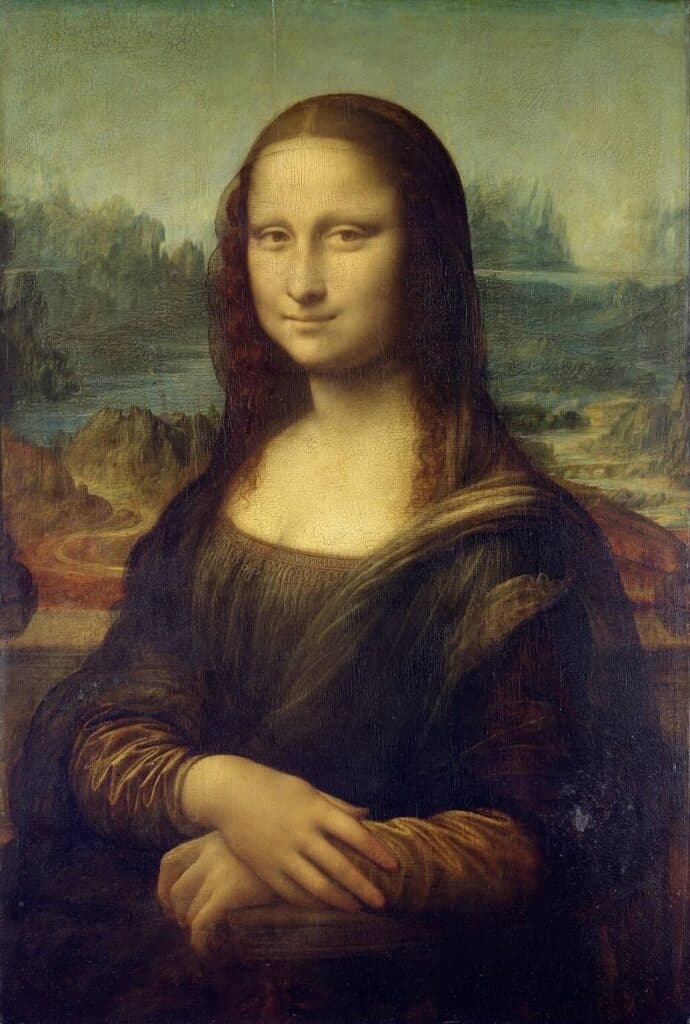
In the Mona Lisa, Leonardo eliminated the hard boundary entirely. Where her jawline meets the atmospheric background, there is no dividing line—only a soft, continuous gradient of light and shadow. The edge becomes ghostly, vanishing the moment you try to pin it down.
This was not a mere stylistic preference; it was a deliberate engineering feat. While his peers viewed painting as a two-dimensional arrangement of shapes, Leonardo treated it as a complex optical simulation. He recognized that human sight does not record images like a static camera. Instead, the brain continuously constructs a fluid, three-dimensional reality out of shifting patterns of light and edge contrast. By blurring those edges, Leonardo stripped the brain of its easiest visual shortcut, forcing the subconscious mind to actively participate in interpreting the painting.
2. The Chemistry of Light Scattering And Sfumato
Achieving this borderless transition required an agonizing level of technical patience. Leonardo did not paint the Mona Lisa with thick, direct brushstrokes. Instead, he engineered an optical stack using a process that merged organic chemistry with microscopic precision.
To create the soft transitions of sfumato, Leonardo applied between 30 and 40 individual glazes over a primed poplar panel. Each layer consisted of tiny amounts of pigment—such as iron oxide, manganese, or burnt umber—suspended in a heavy vehicle of walnut oil and oil-bodied resin.
Recent X-ray fluorescence spectroscopy conducted by the Centre de Recherche et de Restauration des Musées de France revealed that these glazes were applied in impossibly thin increments—some measuring less than two micrometers thick, or roughly 1/50th the width of a human hair.
This multi-layered structure transformed the surface of the painting into a complex optical filter:
- Photonic Penetration: When light strikes the Mona Lisa, it does not immediately bounce off a flat layer of paint. Instead, incoming light photons pass through dozens of semi-transparent film layers.
- Internal Reflection: As light moves deeper into the paint matrix, it hits scattered pigment particles. Some wavelengths are absorbed, while others bounce off deeper glazes, scattering in multiple directions before exiting the surface back toward your eyes.
- Subsurface Scattering: This internal bounce creates an luminous, three-dimensional depth that cannot be replicated with a single coat of opaque paint.
This phenomenon directly mirrors subsurface scattering in organic matter. Human skin is translucent; light penetrates the epidermis, bounces around within the dermal tissue, and scatters before reflecting back out. This light transport gives living skin its soft, radiant quality.
By stacking dozens of microscopic glazes, Leonardo replicated this exact biological behavior. He did not simply paint the color of skin—he recreated the physics of how light interacts with living flesh. In the early 1500s, this created a shocking, almost uncanny sensation of biological reality.
3. Hacking the Retinal Feed And Sfumato
Leonardo’s mastery extended far beyond material science into human neurobiology. Though he lacked modern imaging equipment, his exhaustive anatomical dissections of the human eye allowed him to decipher how the retina transmits visual data to the brain.
The human retina does not process images uniformly. It relies on a structural division of labor between two main zones:
- The Fovea Centralis: The tiny central pit of the retina, packed tightly with cone cells. It processes high spatial frequencies—sharp edges, crisp text, and fine detail. However, it is relatively slow at detecting minor shifts in shadow.
- The Peripheral Retina: The area surrounding the fovea, populated predominantly by rod cells. It lacks sharp acuity and ignores fine detail, but it is extraordinarily sensitive to low spatial frequencies—broad shapes, shadowy gradients, and subtle motion.
Leonardo exploited this visual architecture with mathematical precision.
When you look directly at Lisa Gherardini’s eyes, your peripheral vision takes responsibility for processing her mouth. Because your peripheral retina reads low spatial frequencies, it ignores fine detail and interprets the soft, sfumato shadows around the corners of her lips as an upward curve. To your brain, she is clearly smiling.
However, when you shift your gaze down to look directly at her mouth, your fovea takes over. The high-acuity central vision looks for sharp lines to confirm the smile—and finds none. Without hard contours, the fovea reads the subtle gray tones as flat, neutral shadows. The smile abruptly vanishes.
This creates a dynamic “flicker” effect. As your eye bounces naturally across the canvas, the expression constantly morphs between a subtle smile and a solemn gaze. Leonardo built a kinetic illusion into a static panel, using the viewer’s own eye movements to pull the portrait to life.
4. Bypassing the Optic Nerve and Sfumato
In addition to manipulating peripheral vision, Leonardo was deeply fascinated by what he called “the perspective of disappearance” (prospettiva di perdimento). He was among the first thinkers to recognize that the human visual system relies on a variable depth of field.
When you focus on an object near your face, background details naturally drop out of focus, losing both edge sharpness and contrast. Leonardo applied this principle to create a artificial sense of focal blur across the canvas.
Look closely at the landscape behind the Mona Lisa. The winding roads, rocky crags, and distant bridge do not terminate in sharp boundaries. They dissolve into soft blues and grays, mimicking the atmospheric moisture that scatters light over long distances. More importantly, the left and right sides of the background landscape do not align on the same horizontal plane. The background on the left is visibly lower than the background on the right.

This deliberate misalignment creates a subtle perceptual conflict. When your eyes scan from left to right, your visual cortex struggles to resolve the background into a single, static environment. The lack of sharp lines prevents your brain’s edge-detection network from “locking” onto a single, stable interpretation of the space.
This mechanism operates at the level of human social cognition. In real-life interactions, we rarely judge another person’s emotional state by analyzing static, freeze-framed features. We read micro-expressions—fleeting shifts in muscle tone and shadow that occur in fractions of a second.
By erasing hard edges, Leonardo stripped away the explicit visual markers that allow our brain to quickly categorize an emotion (e.g., “happy,” “sad,” or “angry”). Because the edge-detection pathways in the primary visual cortex cannot find a definitive boundary, the signal passed to the amygdala and fusiform face area remains ambiguous. The brain is forced to continuously guess what it is seeing, projecting its own mood and subconscious expectations onto her face.
The famous ambiguity of the Mona Lisa is not a mystery of intent; it is a structural feature of a painting designed never to settle into a single visual state.
5. The Modern Legacy of Calculated Blur and Sfumato
Five centuries after Leonardo laid down his final glazes, modern science and technology are confirming just how far ahead of his time he truly was.
In computer graphics and digital rendering, engineers face the exact problem Leonardo solved on wood. Early 3D video games and animations looked stiff and unnatural precisely because digital engines rendered objects with mathematically perfect, razor-sharp edges.
To make rendered environments look convincing, modern graphics pipelines rely heavily on algorithms that emulate Leonardo’s glazes:
- Ray Tracing & Light Transport: Modern rendering engines calculate light transport by mathematically simulating photons as they pass through translucent surfaces—the exact same subsurface scattering Leonardo achieved with layered walnut oil.
- Depth of Field & Bokeh: Game engines deliberately apply Gaussian blurs and depth-of-field filters to emulate the human eye’s natural focal limitations, guiding the player’s attention without hard UI markers.
Simultaneously, the emerging field of neuro-aesthetics uses eye-tracking hardware and functional MRI (fMRI) brain scans to decode how the brain responds to art. Pioneering studies, such as those conducted by neurobiologist Margaret Livingstone at Harvard Medical School, have mapped how the fovea and peripheral retina process The Great Wave, the Mona Lisa, and Impressionist works.
These studies prove that Leonardo’s theories on peripheral deception were spot-on: human visual attention moves through a painting based on spatial frequency cues, and soft, borderless transitions actively engage deeper processing layers in the visual cortex.

The Ultimate Bridge
The Mona Lisa continues to captivate millions not because it captures a single woman at a specific moment in time, but because it captures the dynamic, ever-shifting mechanics of human vision itself.
Leonardo da Vinci realized that absolute reality is an illusion created by the mind. By abandoning the comfort of the hard line and mastering the physics of light scattering, he built a bridge between the cold laws of optics and the fluid nature of human consciousness.
His “smoke” was never meant to hide the truth. It was designed to reveal how we truly see: not with a cold, static camera, but through a constant, living dialogue between light, shadow, and the human brain.
Anita Louise Art is dedicated to art education, great artists, and inspiring others to find and create their art. We love art that uplifts and inspires. #ArtToMakeYouSmile! #ArtToMakeYouHappy!
If you want to see any of my art, you can find out more by clicking here. If you are interested in what inspires me and my paintings, you can discover more by clicking here.
We have a free newsletter and would love you to be part of our community; you can subscribe to the newsletter by clicking here. If you have any questions, I would be happy to talk to you anytime. You can reach me, Anita, by clicking here.
Subscribe to our Anita Louise Art YouTube Channel with great videos and information by clicking here.
Join us for our podcast “5 Minutes With Art or Deep Dive with 5 Minutes With Art” Spend just a few minutes a week with us to discover and learn about great art and artists. You can find out more about our podcast by clicking here.
Related Questions
The Myth of the Tortured Artist: Is Suffering the Secret Ingredient to Greatness?
There is a persistent, almost seductive belief in the art world: that to create truly profound work, an artist must first be broken. We have romanticized the “starving artist” and the “mad genius” to the point where we sometimes wonder if stability is the enemy of creativity. But is this true? Is suffering actually a prerequisite for greatness, or is the “Tortured Artist” a myth that does more harm than good?
The Myth of the Tortured Artist: Is Suffering the Secret Ingredient to Greatness? Click here to learn more.
Van Gogh Color Symbolism: The Secret Language of Yellow and Blue and What It Reveals About the Human Soul
If you were to close your eyes and think of the name “Vincent van Gogh,” what do you see? Chances are, it isn’t just a face with a red beard. It’s a vivid display of Van Gogh Color Symbolism—a collision of colors that define his art: the searing, almost blinding yellow of a sunflower set against a swirling, deep-midnight blue. These iconic hues are more than aesthetic choices; they embody the emotional depth and creative vision that make Van Gogh’s work so unforgettable.
Van Gogh Color Symbolism: The Secret Language of Yellow and Blue and What It Reveals About the Human Soul Click here to discover more.
Katsushika Hokusai: The “Old Man Mad About Drawing” Who Changed the World
We often think of “influencers” as a modern phenomenon, but Katsushika Hokusai proves that true influence transcends time and technology. In the 19th century, Katsushika Hokusai was the biggest influencer in the art world—not with a smartphone, but with a woodblock, a bowl of Prussian Blue ink, and a spiritual obsession with a mountain. His groundbreaking work continues to inspire artists and admirers around the globe.