
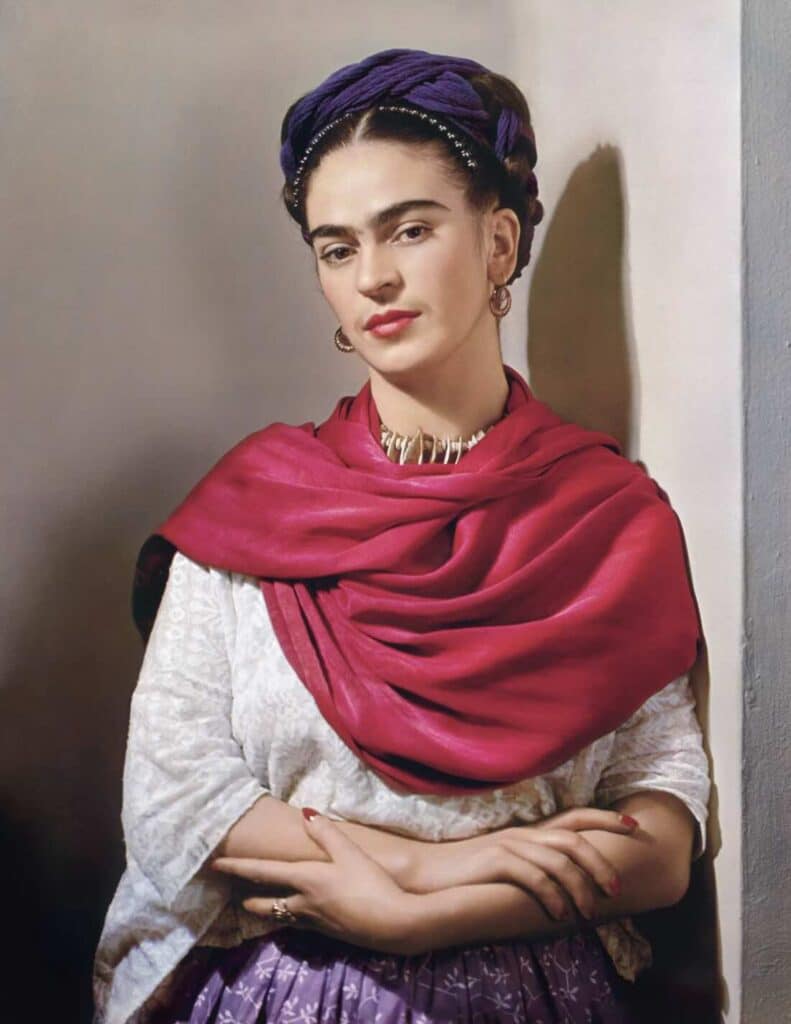
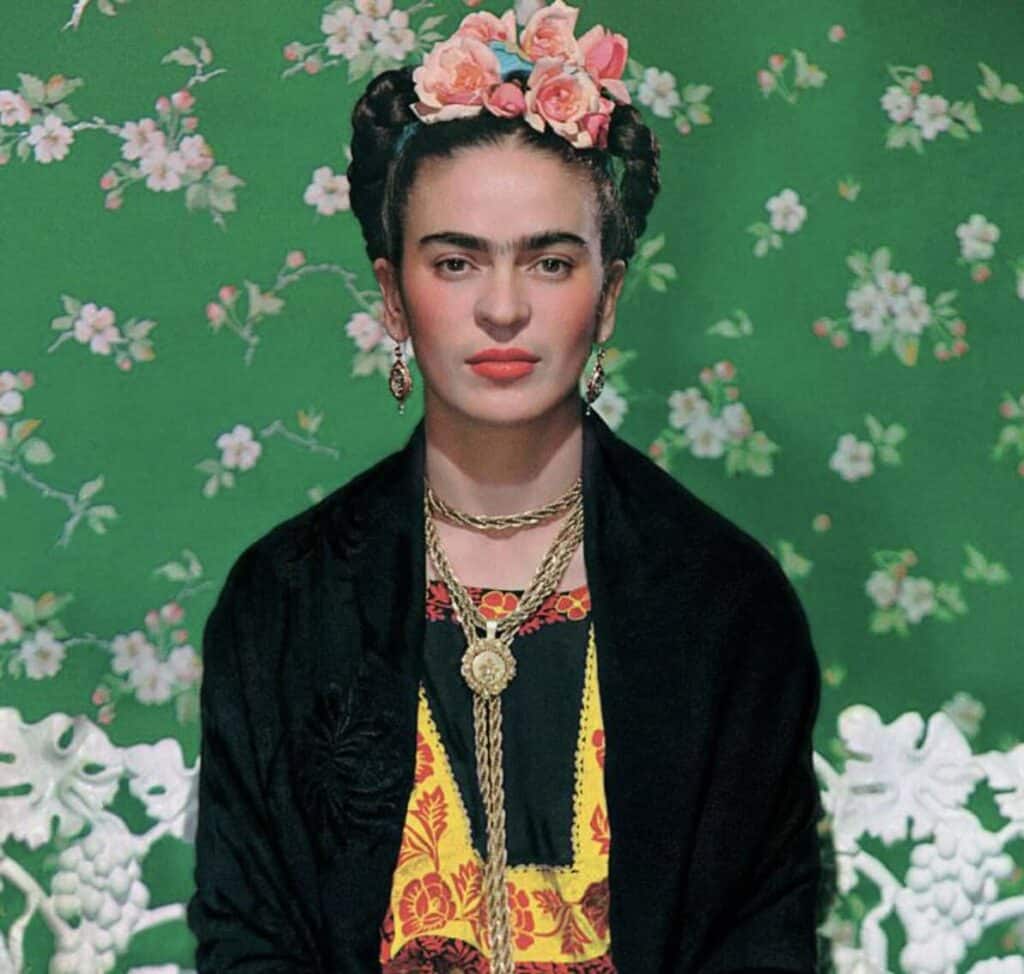
The face of Frida Kahlo is everywhere. You can find her iconic unibrow, braided hair, and floral crowns emblazoned on tote bags, coffee mugs, and t-shirts across the globe. She has become a fixture of pop culture, a recognizable brand of bohemian chic. Yet, beneath this highly commodified image lies the story of a woman whose life was defined by unimaginable physical agony, radical political fervor, and a relentless, groundbreaking commitment to exploring her own identity.
Frida Kahlo did not paint to become a brand; she painted to survive. She used her canvas as a mirror, a surgical table, and a political platform. Her work was a radical departure from the art of her contemporaries, plunging deep into the female experience, chronic illness, and the complexities of a mixed-heritage identity. Today, her legacy endures not just because her paintings are visually arresting, but because her unvarnished vulnerability continues to offer a masterclass in human resilience.
Frida Kahlo: The Crucible of Pain: Early Life and the Accident
Magdalena Carmen Frida Kahlo y Calderón was born on July 6, 1907, in Coyoacán, a vibrant neighborhood in Mexico City. She grew up in La Casa Azul (The Blue House), a home that would remain the gravitational center of her life until her death. Her father, Guillermo Kahlo, was a German photographer of Hungarian descent, and her mother, Matilde Calderón, was a Mexican woman of Indigenous and Spanish heritage. This dual lineage would later become a central theme in her explorations of identity.
Kahlo’s relationship with physical suffering began early. At the age of six, she contracted polio, a disease that left her bedridden for months and permanently withered her right leg. She learned to hide the discrepancy in her limbs beneath long, heavy skirts, but the experience instilled in her a profound sense of physical alienation.
Frida Kahlo And the Accident that Changed Everything
However, it was a near-fatal event in her teenage years that fundamentally altered the trajectory of her life. On September 17, 1925, an 18-year-old Kahlo was riding a wooden bus home from school when it collided violently with a metal streetcar. The devastation to her body was catastrophic. Her spine was broken in three places; her collarbone, ribs, and pelvis were shattered; her right leg was fractured in eleven places; and an iron handrail pierced her abdomen and uterus, effectively destroying her ability to carry a child to term.
Kahlo spent months encased in full-body plaster casts, enduring the first of what would eventually be over 30 surgeries throughout her lifetime. Before the accident, she had been studying to become a doctor. Stripped of her mobility and her intended future, she turned to the only thing she could do from her bed: paint. Her mother ordered a custom easel that allowed her to paint while lying flat, and her father rigged a mirror above her bed.
“I paint myself because I am so often alone,” she famously remarked, “and because I am the subject I know best.” In the crucible of her confinement, the medical student died, and Frida the artist was born.
Frida Kahlo: The Mirror as a Canvas: Radical Self-Portraiture
Of the 143 paintings Kahlo created during her lifetime, 55 are self-portraits. Unlike the traditional portraits of the era, which sought to flatter the subject or elevate their social status, Kahlo’s self-portraits were brutal, unflinching examinations of her physical and emotional state.
She drew heavy inspiration from Mexican retablos—small, brightly colored devotional paintings on tin that were traditionally used to give thanks to Catholic saints for miracles or surviving tragedies. Kahlo adopted this intimate scale and vibrant palette, but instead of painting saints, she painted herself as the martyr.
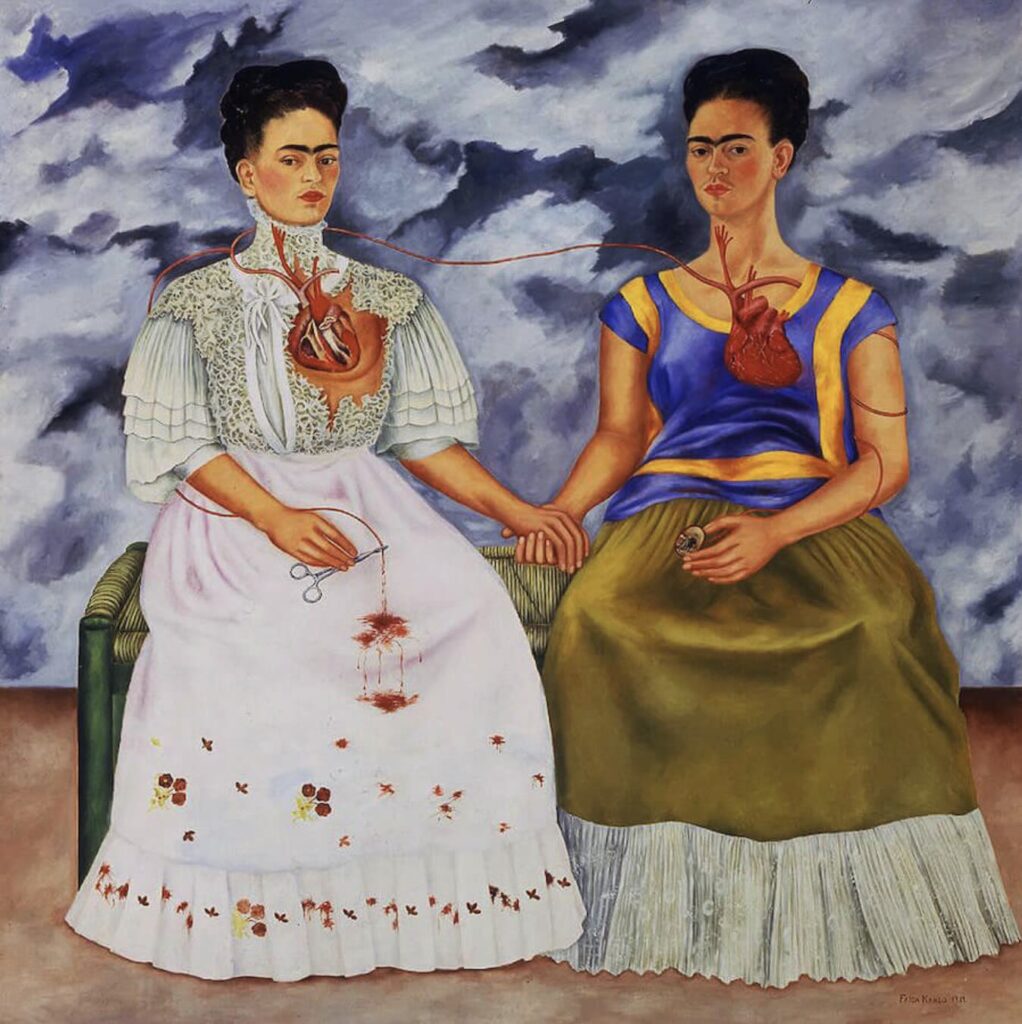
Frida Kahlo And The Two Fridas (1939)
Perhaps her most famous exploration of her fractured identity is The Two Fridas (1939). Painted shortly after her divorce from the famous muralist Diego Rivera, the large-scale double portrait shows two versions of Kahlo sitting side-by-side on a green bench against a turbulent, stormy sky.
On the right sits the “Mexican Frida,” dressed in the traditional Tehuana attire that Rivera loved. Her heart is whole, and she holds a small amulet containing a portrait of Rivera as a child. On the left sits the “European Frida,” dressed in a stark, white, high-necked Victorian lace dress. Her heart is torn open and exposed. A single blood vessel connects the two hearts, but the European Frida has clamped the vein shut with surgical scissors, leaving blood to spill onto her pristine white dress. The painting is a masterpiece of psychological duality, illustrating her torn cultural heritage and the agonizing heartbreak of her divorce.
When French poet André Breton, the founder of the Surrealist movement, visited Mexico, he declared Kahlo a surrealist. Kahlo flatly rejected the label. “They thought I was a Surrealist, but I wasn’t,” she argued. “I never painted dreams. I painted my own reality.” For Kahlo, the floating fetuses, exposed spines, and bleeding hearts were not exercises in dream logic; they were the literal, tangible realities of her daily physical and emotional existence.

The Elephant and the Dove: Frida Kahlo and Life with Diego Rivera
It is impossible to discuss the legacy of Frida Kahlo without examining her tumultuous relationship with Diego Rivera. When they married in 1929, Rivera was already a world-renowned muralist, famously painting massive, politically charged frescoes on public buildings. He was physically massive, decades her senior, and a known philanderer. Kahlo’s parents famously referred to the union as a marriage between “an elephant and a dove.”
Their relationship was defined by intense passion, mutual artistic admiration, and devastating betrayals. Rivera engaged in numerous affairs, most painfully with Kahlo’s own younger sister, Cristina. Kahlo retaliated with her own affairs, engaging in relationships with both men and women, including the exiled Russian revolutionary Leon Trotsky and the American artist Georgia O’Keeffe. The couple divorced in 1939, only to remarry a year later in 1940.
While Rivera painted the macrocosm—the history of Mexico, the struggle of the proletariat, the march of industry—Kahlo painted the microcosm. Her work was intensely domestic and internal. When the couple moved to the United States in the early 1930s for Rivera’s mural commissions in San Francisco, Detroit, and New York, Kahlo experienced profound culture shock. She despised what she called “Gringolandia,” finding it sterile, hyper-capitalist, and devoid of the rich cultural soul of her homeland.
This displacement forced Kahlo to fiercely claim her Mexican identity. In her 1932 painting Self-Portrait on the Borderline Between Mexico and the United States, she stands in a pink dress between two vastly different worlds. On one side are the ancient ruins, native plants, and mythological sun and moon of Mexico. On the other side are the smog-spewing smokestacks, rigid skyscrapers, and cold machinery of the United States. Through her art, she made a definitive choice: she belonged to the earth and history of Mexico.
Frida Kahlo: A Life Forged in Milestones
Kahlo’s life was relatively brief, yet it was punctuated by extraordinary moments of global recognition and intense personal struggle.
Frida Kahlo Birth at La Casa Azul – July 1907
Born in Coyoacán, Mexico. She would later claim she was born in 1910, the year of the Mexican Revolution, wanting her life to begin with the birth of the modern Mexican nation.
The Bus Accident – September 1925
The catastrophic collision that shattered her body, ending her medical studies and confining her to a bed where she began to paint.
Frida Kahlo Marriage to Diego Rivera – August 1929
Kahlo marries the famous muralist, beginning a volatile but deeply influential lifelong partnership.
First Solo Exhibition – November 1938
Kahlo holds her first solo gallery exhibition at the Julien Levy Gallery in New York City, achieving major critical success.
The Louvre Acquires Her Work – 1939
The French government purchases her painting The Frame, making her the first 20th-century Mexican artist to be included in the Louvre’s collection.
First Solo Exhibition in Mexico – April 1953
Failing health prevents her from walking, so she arrives at the gallery opening in an ambulance and attends the exhibition from a four-poster bed installed in the center of the room.
Frida Kahlo Death – July 1954
Frida Kahlo dies at La Casa Azul at the age of 47. The official cause of death was a pulmonary embolism, though some biographers suspect an intentional overdose of painkillers.
Frida Kahlo’ s Politics, Identity, and Defying the Norms
Frida Kahlo was as revolutionary in her politics as she was in her art. She was a staunch Marxist and a member of the Mexican Communist Party. Her commitment to anti-capitalist, anti-imperialist causes was a driving force throughout her life.
In 1937, she and Rivera offered La Casa Azul as a safe haven for Leon Trotsky, who was fleeing assassination attempts orchestrated by Joseph Stalin.
Beyond formal politics, Kahlo politicized her own body and wardrobe. In an era when women were expected to conform to strict European standards of beauty, Kahlo proudly emphasized her unibrow and faint mustache, refusing to alter her natural features to appease the male gaze.
She dressed almost exclusively in the traditional clothing of the Tehuana women—a matriarchal society from the Isthmus of Tehuantepec. Her heavily embroidered blouses, flowing skirts, and intricate braided hairstyles were not just fashion choices; they were deliberate anti-colonial statements. By dressing as an Indigenous woman, she rejected the European cultural imperialism that dominated Mexican high society.
She also subverted gender norms with effortless confidence. She was openly bisexual, taking numerous female lovers throughout her life. In family portraits taken long before her marriage, she can be seen wearing a sharp, tailored men’s three-piece suit, projecting an aura of masculine power and independence in stark contrast to her sisters’ feminine dresses. Kahlo understood that identity was not a fixed, biological mandate, but a performance that could be altered, challenged, and weaponized.
Frida Kahlo and Fridamania: An Ever-Enduring Impact
During her lifetime, Kahlo achieved respect within creative circles, but she was largely overshadowed by Rivera’s fame, often referred to in the press simply as “Diego Rivera’s painting wife.” It was not until the late 1970s and 1980s that her work was rediscovered and elevated to the global stage.
This resurgence—often dubbed “Fridamania”—was largely driven by the feminist movement and the LGBTQ+ community. Feminists championed her as an icon because she painted the female experience with unprecedented honesty.
Before Kahlo, the subjects of miscarriage, infertility, menstruation, and the physical decay of the female body were considered taboo, entirely absent from the canons of fine art. In paintings like Henry Ford Hospital (1932), which explicitly depicts the agony of a miscarriage, Kahlo shattered the silence surrounding women’s trauma.
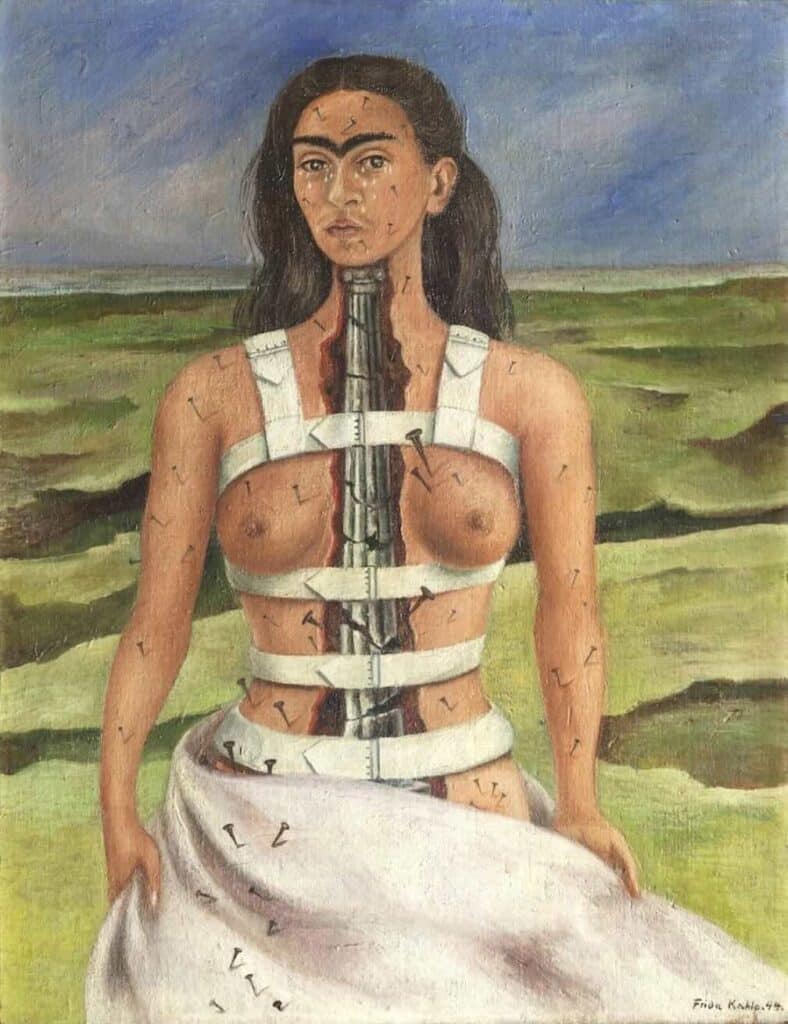
Furthermore, she has become a patron saint for the disability rights movement. Kahlo never tried to erase her disability from her art; she centralized it. In The Broken Column (1944), she paints herself split open, her shattered spine replaced by a crumbling ionic column, her body held together by a medical steel corset.
She even turned her medical apparatuses into works of art, painting elaborate, beautiful designs onto her plaster body casts and, later in life, her prosthetic leg. She showed the world that a disabled body is not something to be hidden or pitied, but something that holds immense power, resilience, and beauty.
In our modern era of hyper-curated social media, Kahlo is often referred to as the mother of the “selfie.” But while modern self-portraiture is frequently used to project a flawless, idealized version of the self, Kahlo used self-portraiture to do the exact opposite. She used it to dissect herself, to show her wounds, her tears, and her ugly truths.

The Immortal Legacy of Frida Kahlo
The legacy of Frida Kahlo is not merely the sum of her paintings; it is the enduring power of her spirit. She took the most isolating, agonizing experiences a human can endure—chronic physical pain, heartbreaking betrayals, the inability to bear children—and transmuted them into a visual language that speaks universally to anyone who has ever suffered.
Today, La Casa Azul is one of the most visited museums in Mexico, a pilgrimage site for those who draw strength from her story. Frida Kahlo remains a towering figure in modern art because she refused to be defeated by her circumstances. She forged her own identity, painted her own reality, and proved that even when the body is broken, the human spirit can remain radically, beautifully intact.
Watch Our Video On Frida Kahlo
Anita Louise Art is dedicated to art education, great artists, and inspiring others to find and create their art. We love art that uplifts and inspires. #ArtToMakeYouSmile! #ArtToMakeYouHappy!
If you want to see any of my art, you can find out more by clicking here. If you are interested in what inspires me and my paintings, you can discover more by clicking here.
We have a free newsletter and would love you to be part of our community; you can subscribe to the newsletter by clicking here. If you have any questions, I would be happy to talk to you anytime. You can reach me, Anita, by clicking here.
Subscribe to our Anita Louise Art YouTube Channel with great videos and information by clicking here.
Join us for our podcast “5 Minutes With Art or Deep Dive with 5 Minutes With Art” Spend just a few minutes a week with us to discover and learn about great art and artists. You can find out more about our podcast by clicking here.
Related Questions
The Myth of the Tortured Artist: Is Suffering the Secret Ingredient to Greatness?
There is a persistent, almost seductive belief in the art world: that to create truly profound work, an artist must first be broken. We have romanticized the “starving artist” and the “mad genius” to the point where we sometimes wonder if stability is the enemy of creativity. But is this true? Is suffering actually a prerequisite for greatness, or is the “Tortured Artist” a myth that does more harm than good?
The Myth of the Tortured Artist: Is Suffering the Secret Ingredient to Greatness? Click here to learn more.
Van Gogh Color Symbolism: The Secret Language of Yellow and Blue and What It Reveals About the Human Soul
If you were to close your eyes and think of the name “Vincent van Gogh,” what do you see? Chances are, it isn’t just a face with a red beard. It’s a vivid display of Van Gogh Color Symbolism—a collision of colors that define his art: the searing, almost blinding yellow of a sunflower set against a swirling, deep-midnight blue. These iconic hues are more than aesthetic choices; they embody the emotional depth and creative vision that make Van Gogh’s work so unforgettable.
Van Gogh Color Symbolism: The Secret Language of Yellow and Blue and What It Reveals About the Human Soul Click here to discover more.