

Imagine walking through the corridors of a former royal palace, surrounded by thousands of years of human creativity, history, and genius. Welcome to the Louvre Museum in Paris. Standing on the Right Bank of the Seine, the Louvre is not just a museum; it is a monument to the endurance of art. With over nine million visitors annually, it holds the undisputed title of the most visited art museum on the planet.
Whether you are an art historian or a casual traveler, taking a virtual tour through the Louvre’s sprawling wings reveals a staggering collection that spans from ancient civilizations to the mid-19th century. In this comprehensive guide, we will explore the rich history of this iconic institution, marvel at its most celebrated masterpieces like the Venus de Milo, and take a detailed look at the massive, forward-thinking changes planned for the museum’s undisputed superstar: Leonardo da Vinci’s Mona Lisa.
The Louvre Museum From Medieval Fortress to Global Icon
To understand the scale and grandeur of the Louvre, one must first look at its architectural evolution. The museum was not built to house art. In 1190, King Philip Augustus constructed a stout fortress on the site to protect Paris from Viking raids and English invasions. If you wander through the lower levels of the Sully Wing today, you can still see the excavated remnants of the medieval keep’s original stone foundations.
By the 16th century, the threat of invasion had waned, and King Francis I decided to demolish the old fortress, replacing it with a lavish Renaissance palace. Over the next few centuries, successive French monarchs expanded the Louvre, turning it into a sprawling complex of royal apartments and grand galleries. It wasn’t until 1682, when King Louis XIV moved his court to the Palace of Versailles, that the Louvre was largely left to house the royal art collection.
The turning point came during the French Revolution. In 1793, the revolutionary government decreed that the Louvre should be a public museum, open to all citizens to enjoy the nation’s masterpieces. It opened with an exhibition of just 537 paintings. Today, the collection boasts over 380,000 objects, with roughly 35,000 on display at any given time.
In the late 20th century, the museum underwent the “Grand Louvre” project, which introduced the now-iconic glass pyramid designed by Chinese-American architect I.M. Pei. Unveiled in 1989, the modern pyramid serves as the main entrance, pulling natural light into the vast underground lobby and creating a striking juxtaposition between contemporary design and classic French Renaissance architecture.

Navigating the Labyrinth of the Louvre Museum A Look at the Collections
The Louvre is so immense that it is famously said you could spend 100 days inside, looking at each piece for just 30 seconds, and still not see everything. The museum is divided into three main wings—Richelieu, Sully, and Denon—each offering a different journey through time.
The Sully Wing is the oldest part of the museum, built around the Cour Carrée (Square Court). It is home to the extensive Egyptian Antiquities collection, where you can find the hauntingly beautiful Seated Scribe and the Great Sphinx of Tanis.
The Richelieu Wing houses Near Eastern Antiquities, including the monumental Code of Hammurabi, one of the oldest deciphered writings of significant length in the world. This wing also features the opulent Napoleon III Apartments, preserving the lavish decorative arts of the 19th-century French empire.
The Denon Wing is perhaps the most heavily trafficked, and for good reason. It houses the vast collection of Italian Renaissance paintings, sprawling French Romantic canvases, and classical Roman and Greek sculptures.

Masterpieces Carved in Stone: The Venus de Milo at The Louvre Museum
Among the millions of visitors who flock to the Louvre, many are on a quest to see a specific subset of masterpieces. In the Department of Greek, Etruscan, and Roman Antiquities on the ground floor of the Sully Wing stands one of the most famous sculptures in the history of art: the Venus de Milo.
Discovered in 1820 by a peasant on the Greek island of Milos, this larger-than-life marble statue is believed to depict Aphrodite, the Greek goddess of love and beauty (known to the Romans as Venus). Carved during the Hellenistic period, sometime between 130 and 100 BCE, the statue is celebrated for its classical symmetry, the realistic drapery resting on her hips, and the idealized beauty of her form.
The mystery of her missing arms has only added to her allure. While fragments of an arm holding an apple were found near the statue upon its discovery, it was never conclusively proven they belonged to the Venus. The Louvre chose to display her as she was found, allowing her fragmented state to become an iconic symbol of ancient survival. She is a testament to the endurance of classical ideals, drawing viewers into a silent conversation that spans millennia.

The Grande Galerie: Walking Through Art History at The Louvre Museum
Leaving the ancient world behind, ascending to the first floor of the Denon Wing brings you to the Grande Galerie. This seemingly endless, naturally lit corridor is one of the most breathtaking architectural spaces in Paris.
Walking down this quarter-mile-long hall is a literal walk through the evolution of European painting. The walls are lined with masterpieces by Italian masters such as Raphael, Titian, and Caravaggio. The gallery serves as a prelude to the massive French canvases housed nearby, including Jacques-Louis David’s The Coronation of Napoleon and Eugène Delacroix’s Liberty Leading the People. The sheer volume of genius concentrated in this single wing is staggering, but for most visitors, the Grande Galerie is merely the pathway to the museum’s undisputed crown jewel.

The Crown Jewel of The Louvre Museum: Leonardo’s Mona Lisa
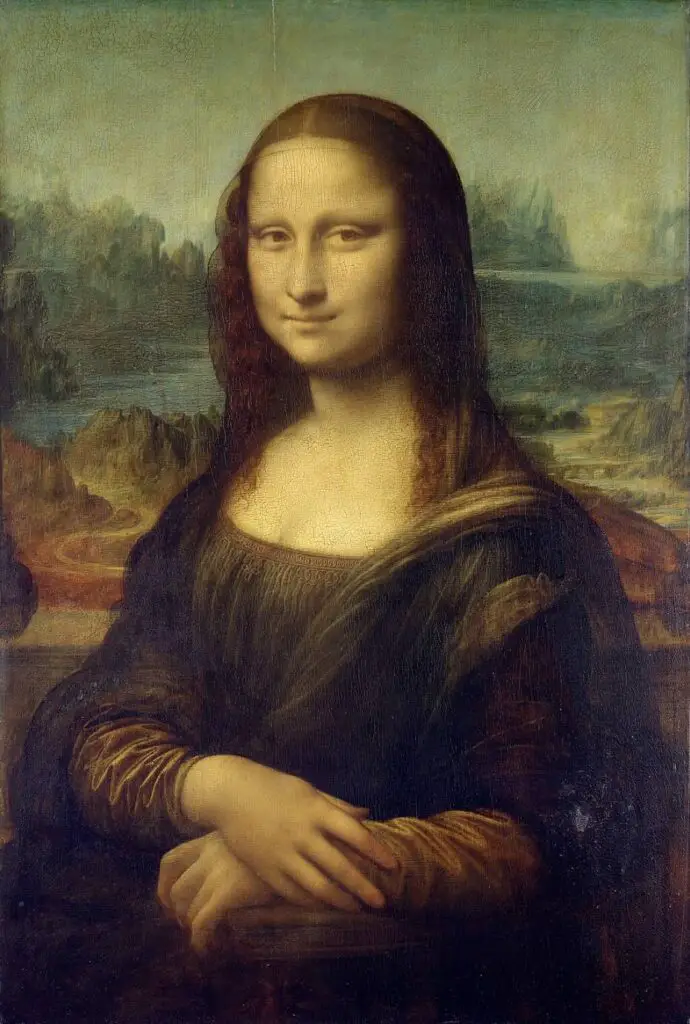
In the center of the Denon Wing, inside the museum’s largest room (the Salle des États), sits a relatively small portrait measuring just 30 by 21 inches. Painted by the ultimate Renaissance man, Leonardo da Vinci, in the early 16th century, the Portrait of Lisa Gherardini, universally known as the Mona Lisa (or La Joconde in French), transcends the art world to act as a global cultural icon.
What makes the Mona Lisa so captivating? Beyond her famously enigmatic smile, the painting is a masterclass in Leonardo’s pioneering techniques.
Get up close to the brushwork—or lack thereof—and you can see exactly why Leonardo’s technique changed painting forever.
https://36u4zrfkqkh5ulk7qwwh86dzd82w9wv7jg7ssb24lyo9hixo2x-h917864466.scf.usercontent.goog/gemini-code-immersive/shim.html?origin=https%3A%2F%2Fgemini.google.com&cache=1
Key insight: Leonardo utilized sfumato (meaning “vanished or evaporated like smoke” in Italian), a technique of applying dozens of microscopic layers of translucent oil glazes to blur the sharp transitions between colors and tones. This creates the incredibly lifelike, soft shading around her eyes and mouth, making her expression shift depending on where the viewer focuses. Furthermore, his use of atmospheric perspective in the jagged, icy background gives the portrait an unprecedented illusion of depth.
Currently, however, appreciating these subtle technical marvels in person is incredibly difficult. The Mona Lisa attracts up to 30,000 visitors a day. She sits behind bulletproof, anti-reflective glass, guarded by a wooden barrier that keeps the public several feet away. The Salle des États is chronically overcrowded, noisy, and chaotic, with most visitors granted less than a minute at the front of the queue to snap a quick photo before being ushered along.
Recognizing that this frenetic environment does a disservice to both the artwork and the public, the Louvre has announced a revolutionary plan to change how the world views its most famous face.
“A Room of Her Own”: The Mona Lisa’s New Chamber at The Louvre Museum
In a major bid to resolve the intense crowding and modernize the museum’s aging infrastructure, the Louvre has officially launched the “Louvre Nouvelle Renaissance” (New Renaissance) project. The centerpiece of this multi-hundred-million-euro overhaul is a radical relocation plan for Leonardo’s masterpiece.
By the early 2030s, the Mona Lisa will be moved from the overcrowded Salle des États into a specially designed, subterranean suite located beneath the Louvre’s eastern courtyard, the Cour Carrée. This initiative, widely dubbed “A Room of Her Own,” is poised to completely redefine the visitor experience.
A 2,000-Square-Meter Chamber – The Mona Lisa’s New Chamber at The Louvre Museum
The new space will be massive—a 2,000-square-meter, climate-controlled chamber tailored specifically to house the Mona Lisa. This expansive gallery will not only ensure the optimal preservation of the fragile poplar wood panel but will also allow visitors to spread out. The goal is to replace the current rushed, elbow-to-elbow viewing with a calmer, more immersive, and educational atmosphere where the painting’s historical and artistic context can be fully appreciated.
Dedicated Access at The Mona Lisa’s New Chamber at The Louvre Museum
Perhaps the most significant change is how people will reach the painting. The new subterranean gallery will feature its own separate access point, connected to a newly designed eastern entrance at the Colonnade de Perrault. This means that tourists will eventually be able to view the Mona Lisa directly without having to navigate—and congest—the rest of the museum’s wings.
Special Ticketing to Manage Crowds at The Mona Lisa’s New Chamber at The Louvre Museum
To further stagger and manage the massive influx of daily visitors, accessing this new gallery will require a specialized, separate ticket. This decoupled ticketing strategy aims to streamline crowd flow, ensuring that those who strictly want to see the Mona Lisa can do so efficiently, while freeing up the rest of the museum for visitors who wish to explore the Louvre’s broader collection in peace.
Fixing Chronic Overcrowding at The Mona Lisa’s New Chamber at The Louvre Museum
The current glass pyramid entrance, built to handle roughly four million annual visitors, is vastly ill-equipped for today’s crowds of over nine million. By diverting the “Mona Lisa traffic” to a dedicated eastern entrance and subterranean chamber, the Louvre hopes to alleviate the severe bottlenecks at the pyramid and inside the Denon Wing.
Expected to open to the public around 2031, this sweeping overhaul represents the most significant architectural and logistical transformation of the Louvre since the 1980s.

The Future of The Louvre Museum
The Louvre Museum is a living, breathing institution that must constantly adapt to the demands of the modern era. The “New Renaissance” project and the creation of a dedicated chamber for the Mona Lisa highlight a delicate balancing act faced by all major cultural heritage sites: how to provide global access to iconic artifacts while ensuring their preservation and maintaining a meaningful, dignified viewing experience.
Until the new doors open in 2031, the Louvre remains a magnificent labyrinth of human history. Whether you come to marvel at the classical perfection of the Venus de Milo, to walk the grand halls of French monarchs, or to catch a fleeting glimpse of Lisa Gherardini’s famous smile, a visit to the Louvre is an unforgettable journey through the very best of what humanity has created.
Anita Louise Art is dedicated to art education, great artists, and inspiring others to find and create their art. We love art that uplifts and inspires. #ArtToMakeYouSmile! #ArtToMakeYouHappy!
If you want to see any of my art, you can find out more by clicking here. If you are interested in what inspires me and my paintings, you can discover more by clicking here.
We have a free newsletter and would love you to be part of our community; you can subscribe to the newsletter by clicking here. If you have any questions, I would be happy to talk to you anytime. You can reach me, Anita, by clicking here.
Subscribe to our Anita Louise Art YouTube Channel with great videos and information by clicking here.
Join us for our podcast “5 Minutes With Art or Deep Dive with 5 Minutes With Art” Spend just a few minutes a week with us to discover and learn about great art and artists. You can find out more about our podcast by clicking here.
Related Questions
The Myth of the Tortured Artist: Is Suffering the Secret Ingredient to Greatness?
There is a persistent, almost seductive belief in the art world: that to create truly profound work, an artist must first be broken. We have romanticized the “starving artist” and the “mad genius” to the point where we sometimes wonder if stability is the enemy of creativity. But is this true? Is suffering actually a prerequisite for greatness, or is the “Tortured Artist” a myth that does more harm than good?
The Myth of the Tortured Artist: Is Suffering the Secret Ingredient to Greatness? Click here to learn more.
Van Gogh Color Symbolism: The Secret Language of Yellow and Blue and What It Reveals About the Human Soul
If you were to close your eyes and think of the name “Vincent van Gogh,” what do you see? Chances are, it isn’t just a face with a red beard. It’s a vivid display of Van Gogh Color Symbolism—a collision of colors that define his art: the searing, almost blinding yellow of a sunflower set against a swirling, deep-midnight blue. These iconic hues are more than aesthetic choices; they embody the emotional depth and creative vision that make Van Gogh’s work so unforgettable.
Van Gogh Color Symbolism: The Secret Language of Yellow and Blue and What It Reveals About the Human Soul Click here to discover more.
Katsushika Hokusai: The “Old Man Mad About Drawing” Who Changed the World
We often think of “influencers” as a modern phenomenon, but Katsushika Hokusai proves that true influence transcends time and technology. In the 19th century, Katsushika Hokusai was the biggest influencer in the art world—not with a smartphone, but with a woodblock, a bowl of Prussian Blue ink, and a spiritual obsession with a mountain. His groundbreaking work continues to inspire artists and admirers around the globe.