
History tells us that Wassily Kandinsky invented abstract art in 1910 when he painted a fluid, untitled watercolor devoid of recognized objects. For over a century, art textbooks, museum curation, and gallery lectures held this as absolute truth. Pioneers like Piet Mondrian, Kazimir Malevich, and Robert Delaunay were framed as the heroic vanguard—the men who stripped away the physical world to reveal pure, non-objective form. History is wrong – it is Hilma af Klint.
Years before Kandinsky put brush to canvas for his celebrated breakdown of form, a Swedish woman was quietly sitting in a sunlit Stockholm studio, receiving secret transmissions from the spirit world. In 1906—four full years before Kandinsky’s breakthrough—Hilma af Klint began painting massive, radical, geometric canvases unlike anything the Western world had ever seen. She did not merely dabble in abstraction; she created an entirely new visual language spanning over 1,200 works. Yet, for nearly a century, her name was completely absent from the canon.
The Rewritten History of Firsts and Hilma af Klint
The myth of Kandinsky as the sole father of abstract art began to fracture in 2018 when the Solomon R. Guggenheim Museum in New York hosted Hilma af Klint: Paintings for the Future. Expecting modest crowds for a posthumous retrospective of a little-known Swedish artist, the museum was instead inundated.
The exhibition became the most visited show in the Guggenheim’s 80-year history, drawing over 600,000 visitors.
Standing in the museum’s famous spiral ramp, viewers were confronted with towering 10-foot-tall canvases bursting with radiant botanical swirls, glowing pastel discs, and vibrant yellow and pink fields of color. The sheer scale and maturity of the work made one thing undeniably clear: these were not rough drafts or accidental experiments. They were complete, authoritative masterpieces created between 1906 and 1915.
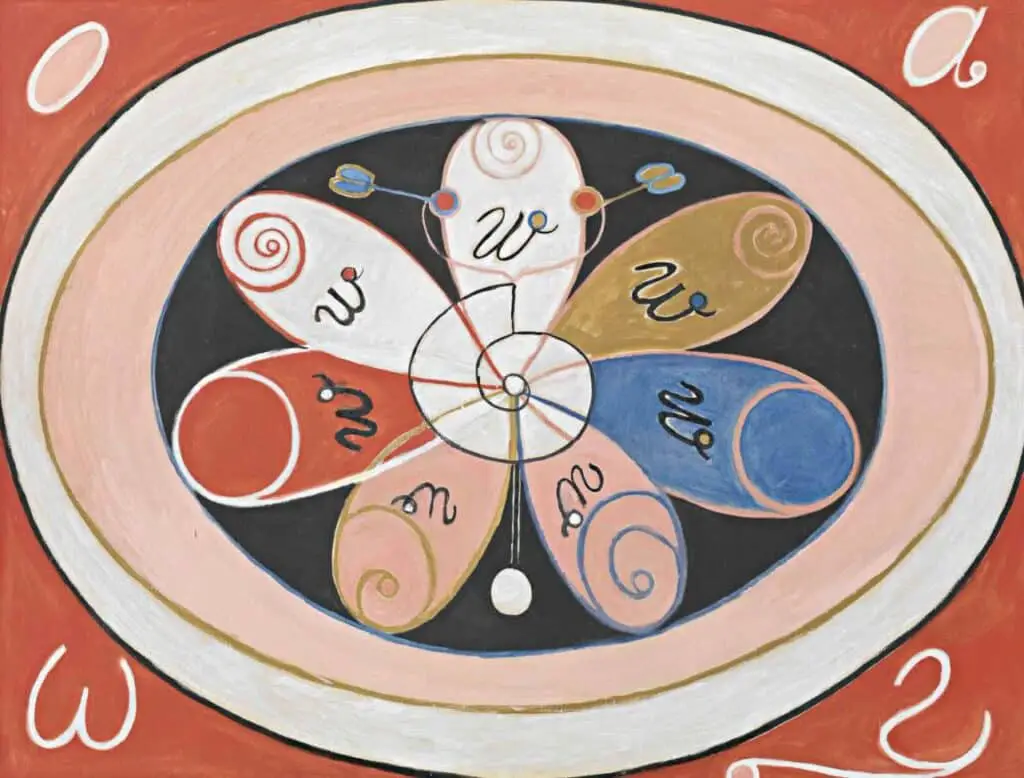
The realization shattered the traditional timeline of modern art, raising an unsettling question: how could a woman producing such radical, visionary art in 1906 remain entirely invisible to the art world for over a hundred years?
The answer lies at the intersection of early 20th-century sexism, the art establishment’s deep bias against spiritualism, and af Klint’s own deliberate, protective secrecy.
The Occult Laboratory of “The Five”
To understand where these canvases came from, one must look to 1896 Stockholm. Hilma af Klint was not a self-taught outsider; she was a classically trained graduate of the Royal Swedish Academy of Fine Arts, earning a living painting traditional naturalistic landscapes and portraits. But behind her respectable academic career lay a radical double life.
Devastated by the death of her younger sister Hermina in 1880, af Klint turned toward spiritism, theosophy, and rosicrucianism—movements sweeping through Europe as people sought to reconcile scientific discovery with spiritual existence.
Af Klint formed a secret spiritualist group known as De Fem (The Five), consisting of five women artist-friends:
- Hilma af Klint
- Anna Cassel
- Cornelia Cederberg
- Sigrid Hedman
- Mathilda Nilsson
Every Friday, The Five met in total secrecy. They began with prayer, meditated, read scripture, and conducted seances. Together, they claimed to make contact with high spiritual masters—beings they named Gregor, Georg, Amaliel, Ananda, and Pleasure.
During these sessions, the women practiced automatic drawing and writing—a technique where they allowed their hands to move across paper unguided by conscious thought. This was decades before the French Surrealists would claim automatic drawing as their own revolutionary invention in the 1920s.
Through these mediumistic trances, The Five bypassed academic convention. Where traditional art taught rigid perspective and physical imitation, their spiritual sessions unlocked fluid geometric motifs, swirling spirals, overlapping circles, and intricate diagrams of unseen forces.
In 1906, during one of these Friday gatherings, the spirit Amaliel gave af Klint a monumental commission: she was chosen to construct a series of works that would represent the spirit realm on physical canvas. It was to be called the Paintings for the Temple.
Decoding the Secret Visual Language
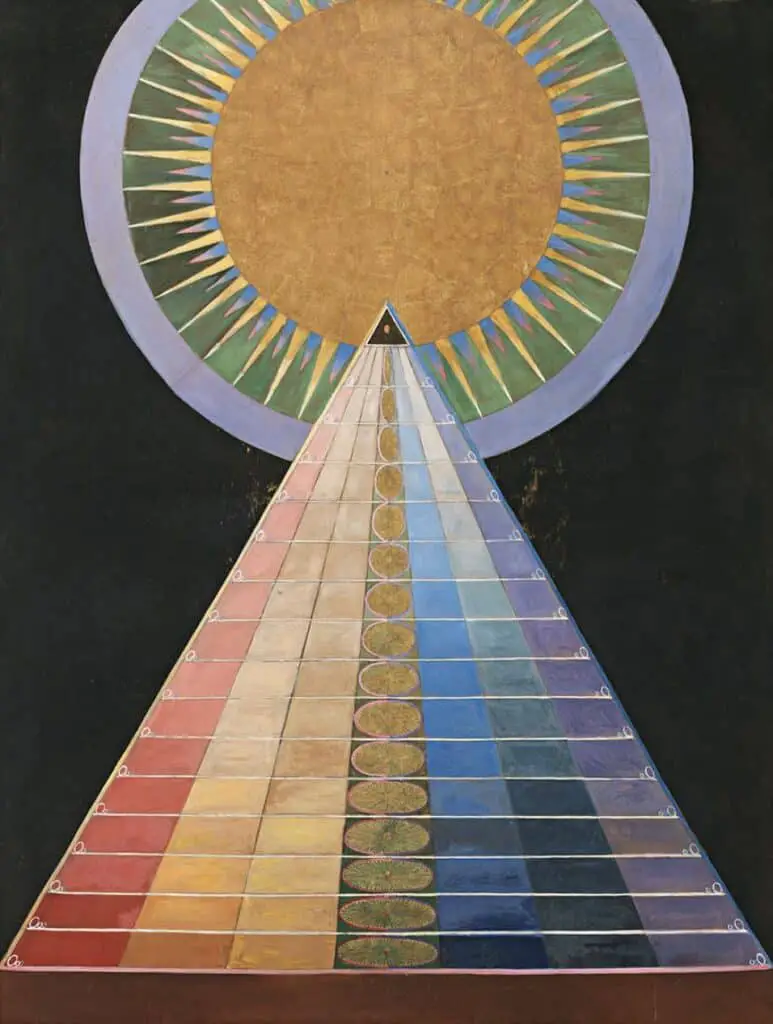
Between 1906 and 1915, working with intense speed and singular focus, af Klint executed 193 canvases for the Paintings for the Temple. Among the most celebrated of these are The Ten Largest, a set of massive 10-by-8-foot canvases completed in just 40 days during the autumn of 1907.
The series maps the four stages of human development: Childhood, Youth, Adulthood, and Old Age. Rather than depicting human figures, af Klint rendered these stages using a sophisticated visual alphabet of colors and shapes:
- Colors as Forces: Blue represented the female principle (intellect, spirit); yellow represented the male principle (light, warmth, energy); green signaled the synthesis of the two.
- Dualistic Geometry: Spirals symbolized evolution and growth, loops represented infinity, and overlapping circles depicted unity and balance.
- Botanical Synthesis: Her background in scientific illustration and botany fed directly into her spiritual work. Microscopic plant cells, seed pods, and atomic structures merged with esoteric symbols to map forces like gravity, electromagnetism, and light waves.
“The pictures were painted directly through me, without any preliminary drawings and with great force. I had no idea what the paintings were supposed to depict; nevertheless, I worked swiftly and surely, without changing a single brush stroke.”
— Hilma af Klint, Notebook entries
At a time when mainstream art was still obsessed with depicting physical objects, af Klint was attempting something far more ambitious: painting the invisible dimensions of reality that science was just beginning to discover, such as X-rays, radiation, and subatomic particles.

A Legacy Intentionally Buried
If af Klint’s work was so vast and extraordinary, why did it take a century for it to reach the light?
Part of the answer lies with her contemporary, the renowned Austrian philosopher and founder of Anthroposophy, Rudolf Steiner. In 1908, af Klint invited Steiner to her Stockholm studio to view her Paintings for the Temple. She hoped he would validate the spiritual origin of her work. Instead, Steiner was critical. He rejected her mediumistic process, cautioning that true spiritual art should not be channelled through trance states, and declared that the world would not understand her paintings for another 50 years.
Devastated by his reaction, af Klint paused painting for four years. Steiner’s rejection deeply reinforced her own growing belief that society was not yet ready to process the spiritual frequencies embedded in her art.
When af Klint died in a streetcar accident in 1944 at the age of 81—the exact same year both Wassily Kandinsky and Piet Mondrian died—she left behind strict instructions in her will:
Her entire body of abstract work—over 1,200 paintings and 124 notebooks—was to be kept hidden and sealed for at least 20 years after her death.

Her instructions were strictly honored by her nephew, Erik af Klint. However, when the 20-year moratorium passed in 1964, the art establishment proved Steiner’s prediction right. The Moderna Museet in Stockholm was offered her entire collection as a gift; the director flatly rejected it, dismissing the works because of their occult background and mediumistic origins.
For decades, male modernists like Kandinsky were celebrated as intellectual geniuses who theorized their way into abstraction, while female artists engaging with spiritual themes were marginalized as mere “mediums” or practicing decorative craft.
The Final Shift in Global Perspective
Today, the tide has irreversibly turned. The discovery of Hilma af Klint’s work has forced art historians to radically re-evaluate the origins of modernism.
Massive digital archiving and restoration projects are making her complete 1,200-piece collection accessible to the global public. Her influences can be seen rippling across contemporary culture, inspiring everything from minimalist interior architecture to modern psychological and conceptual art.
The story of Hilma af Klint forces us to redefine what it means to be an artistic pioneer. A true pioneer does not create for immediate fame, gallery representation, or market validation. Hilma af Klint painted for a world that did not yet exist—sacrificing immediate recognition so that her canvases could serve as a message to the future.
She was not just the first abstract painter of the Western world; she was an artist who understood that true vision is often invisible to the time in which it is born.
Anita Louise Art is dedicated to art education, great artists, and inspiring others to find and create their art. We love art that uplifts and inspires. #ArtToMakeYouSmile! #ArtToMakeYouHappy!
If you want to see any of my art, you can find out more by clicking here. If you are interested in what inspires me and my paintings, you can discover more by clicking here.
We have a free newsletter and would love you to be part of our community; you can subscribe to the newsletter by clicking here. If you have any questions, I would be happy to talk to you anytime. You can reach me, Anita, by clicking here.
Subscribe to our Anita Louise Art YouTube Channel with great videos and information by clicking here.
Join us for our podcast “5 Minutes With Art or Deep Dive with 5 Minutes With Art” Spend just a few minutes a week with us to discover and learn about great art and artists. You can find out more about our podcast by clicking here.
Related Questions
The Myth of the Tortured Artist: Is Suffering the Secret Ingredient to Greatness?
There is a persistent, almost seductive belief in the art world: that to create truly profound work, an artist must first be broken. We have romanticized the “starving artist” and the “mad genius” to the point where we sometimes wonder if stability is the enemy of creativity. But is this true? Is suffering actually a prerequisite for greatness, or is the “Tortured Artist” a myth that does more harm than good?
The Myth of the Tortured Artist: Is Suffering the Secret Ingredient to Greatness? Click here to learn more.
Van Gogh Color Symbolism: The Secret Language of Yellow and Blue and What It Reveals About the Human Soul
If you were to close your eyes and think of the name “Vincent van Gogh,” what do you see? Chances are, it isn’t just a face with a red beard. It’s a vivid display of Van Gogh Color Symbolism—a collision of colors that define his art: the searing, almost blinding yellow of a sunflower set against a swirling, deep-midnight blue. These iconic hues are more than aesthetic choices; they embody the emotional depth and creative vision that make Van Gogh’s work so unforgettable.
Van Gogh Color Symbolism: The Secret Language of Yellow and Blue and What It Reveals About the Human Soul Click here to discover more.
Katsushika Hokusai: The “Old Man Mad About Drawing” Who Changed the World
We often think of “influencers” as a modern phenomenon, but Katsushika Hokusai proves that true influence transcends time and technology. In the 19th century, Katsushika Hokusai was the biggest influencer in the art world—not with a smartphone, but with a woodblock, a bowl of Prussian Blue ink, and a spiritual obsession with a mountain. His groundbreaking work continues to inspire artists and admirers around