
Edvard Munch’s The Scream shows us that art has always served as a mirror to the human soul, revealing our deepest fears, joys, and desires. Few works capture the raw emotional intensity of the human experience quite like Edvard Munch’s The Scream.
This haunting masterpiece has become a universal symbol of anxiety, resonating across cultures and generations. To truly understand its significance, we must delve into both the life of its creator, Edvard Munch, and the context in which The Scream emerged as a powerful visual expression of modern existential dread.

Edvard Munch: The Artist Behind the Agony
Born in 1863 in Loten, Norway, Edvard Munch was raised in an environment marked by tragedy and illness. His mother died of tuberculosis when he was just five years old, and his beloved sister Sophie succumbed to the same disease at fourteen.
Munch’s father, a deeply religious man, struggled to cope with the losses, and his intense piety left a lasting impression on Edvard. These early experiences of grief and instability would profoundly shape Munch’s worldview and artistic vision.
Munch’s childhood was further colored by his own fragile health. He was often ill and spent long periods confined indoors, fostering a sense of isolation and introspection.
As he grew older, Munch’s family moved to Christiania (now Oslo), where he began to study engineering before ultimately pursuing his true passion: art. He enrolled at the Royal School of Art and Design, quickly distinguishing himself with his unconventional style and deeply personal subject matter.
Munch’s early works were influenced by the naturalism and realism of the late nineteenth century, but he soon gravitated toward the Symbolist movement.
Symbolism, with its emphasis on emotional expression and psychological depth, allowed Munch to explore themes of love, death, and existential anxiety. His paintings often depicted figures in states of distress, isolation, or despair—reflecting the turmoil within his own mind.
Throughout his career, Munch struggled with mental health issues. He suffered from anxiety and depression, and his personal relationships were often fraught with tension. Yet, these struggles fueled his creativity, leading him to produce works that resonate with viewers on a profound level. Munch once wrote, “Illness, madness, and death were the black angels that kept watch over my cradle,” a sentiment that echoes throughout his art.
Edvard Munch’s The Scream: A Haunting Vision
Edvard Munch’s The Scream is undoubtedly Munch’s most famous painting, and it stands as a touchstone of modern art.
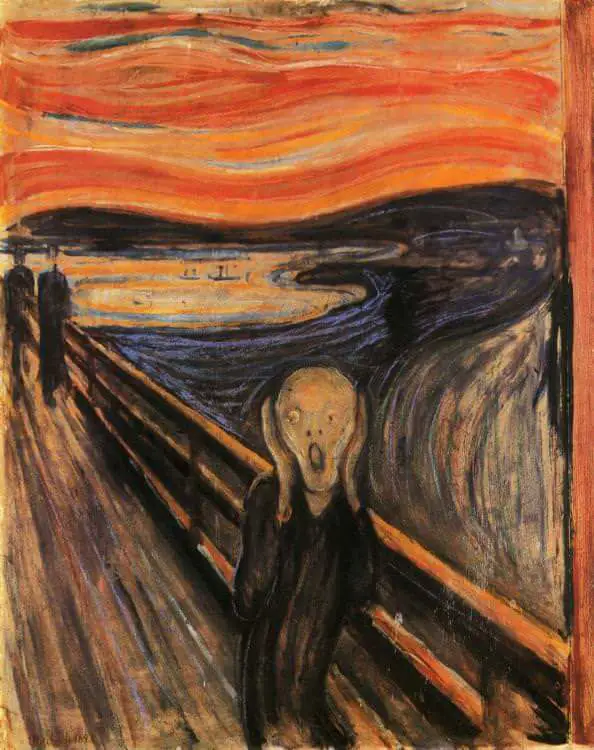
Created in 1893, Edvard Munch’s The Scream was part of a series called The Frieze of Life, which explored themes of love, anxiety, and mortality. The painting itself exists in several versions—two paintings, two pastels, and a number of lithographs—testifying to its importance in Munch’s oeuvre.
The image is instantly recognizable: a figure stands on a bridge, hands pressed to the sides of their face, mouth open in a silent scream. The sky swirls with vivid reds and oranges, while the landscape undulates with an almost hallucinatory intensity.
Two shadowy figures stand in the background, seemingly oblivious to the central figure’s distress. The composition is both simple and deeply unsettling, drawing the viewer into the emotional turmoil of the scene.
Munch described the inspiration for The Scream in his diary:
“I was walking along the road with two friends. The sun was setting. Suddenly, the sky turned blood red. I paused, feeling exhausted, and leaned on the fence. There was blood and tongues of fire above the blue-black fjord and the city. My friends walked on, and I stood there trembling with anxiety—and I sensed an infinite scream passing through nature.”
Edvard Munch
This passage reveals the personal and existential nature of the painting. The Scream is not just a depiction of an individual’s agony; it is a representation of universal anxiety, a response to the overwhelming forces of nature and existence.
Emotional Intensity and Artistic Innovation and Edvard Munch’s The Scream
The emotional intensity of Edvard Munch’s The Scream is heightened by Munch’s innovative use of color and form. The swirling sky, painted with bold strokes of red and orange, conveys a sense of chaos and violence.
The landscape seems to ripple and distort, mirroring the psychological turmoil of the central figure. Munch’s use of line and color was radical for its time, breaking away from traditional realism to create a more expressive, subjective vision.
The figure itself is ambiguous—neither male nor female, neither young nor old. This ambiguity allows viewers to project their own emotions onto the figure, making The Scream a universal symbol of distress. The open mouth and wide eyes evoke a primal sense of fear, while the hands pressed to the face suggest both horror and helplessness.
Munch’s technique was also groundbreaking. He used tempera and pastels on cardboard, rather than canvas, giving the painting a rough, tactile quality. The immediacy of the medium enhances the sense of urgency and panic. Munch’s lithographs of The Scream further spread its image, making it accessible to a wider audience and cementing its status as an icon.

Cultural Significance: Edvard Munch’s The Scream as a Universal Symbol
Over the years, Edvard Munch’s The Scream has transcended its origins to become a cultural phenomenon. It has been referenced, parodied, and reproduced in countless forms—from cartoons and advertisements to films and memes. The image’s universality lies in its ability to capture the essence of modern anxiety.
At the turn of the twentieth century, society was undergoing rapid transformation. Industrialization, urbanization, and scientific progress brought both excitement and uncertainty. Traditional values were being challenged, and the pace of life was accelerating. In this context, The Scream spoke to a collective sense of unease—a feeling that the world was changing too quickly, and that individuals were powerless to stop it.
Psychologists and philosophers have often cited Edvard Munch’s The Scream as a visual representation of existential anxiety. The painting’s central figure, alone and overwhelmed, embodies the isolation and fear that many experience in the face of an indifferent universe. Munch’s work prefigures the existentialist movement, which would later explore themes of alienation, dread, and authenticity.
The Scream’s enduring relevance is evident in its continued popularity. In times of crisis—whether personal, political, or global—people turn to The Scream as a symbol of their own struggles. The painting’s ability to evoke empathy and understanding makes it a powerful tool for exploring the human condition.
Edvard Munch’s The Scream and Modern Conversations about Anxiety
In today’s world, anxiety is a pervasive issue. The pressures of modern life—work, relationships, technology, and societal expectations—can leave individuals feeling overwhelmed and isolated.
Edvard Munch’s The Scream’s depiction of existential dread resonates with contemporary audiences, offering a visual language for emotions that are often difficult to articulate.
Discussing Edvard Munch’s The Scream is important because it opens a dialogue about mental health and emotional vulnerability. Munch’s willingness to confront his own fears and anxieties in his art encourages others to do the same. By acknowledging the “scream” within ourselves, we can begin to address the root causes of our distress and seek support.
The painting also challenges the stigma surrounding mental illness. Munch’s struggles were integral to his creative process, and his art demonstrates that suffering can be transformed into something meaningful and beautiful. The Scream reminds us that anxiety is not a weakness, but a shared human experience.
Edvard Munch’s The Scream in Popular Culture
Edvard Munch’s The Scream’s influence extends far beyond the world of fine art. Its iconic image has been appropriated in countless ways, reflecting its status as a symbol of modern anxiety. The painting has appeared in movies, television shows, and advertisements, often used to evoke a sense of panic or urgency.
One of the most famous references is in the horror film franchise “Scream,” where the killer wears a mask inspired by Munch’s painting. The mask’s distorted features and open mouth mirror the painting’s central figure, linking the themes of terror and existential dread.
The Scream has also been used in political and social commentary. Artists and activists have employed the image to highlight issues such as climate change, war, and inequality. The painting’s ability to convey a sense of urgency and distress makes it a powerful tool for raising awareness and inspiring action.

The Theft and Recovery of Edvard Munch’s The Scream
The Scream’s fame has made it a target for theft and vandalism. In 1994, the painting was stolen from the National Gallery in Oslo by a group of thieves who took advantage of the distractions during the Winter Olympics. The painting was recovered later that year, but the theft underscored the painting’s cultural value and vulnerability.
In 2004, another version of The Scream was stolen from the Munch Museum in Oslo, along with Munch’s Madonna. The paintings were recovered two years later, but both had suffered damage. These incidents highlighted the importance of protecting cultural heritage and preserving works of art for future generations.
Edvard Munch’s The Scream as a Personal Experience
For many viewers, encountering The Scream is a deeply personal experience. The painting’s ability to evoke intense emotions and provoke reflection makes it a powerful catalyst for self-exploration. Standing before The Scream, one is confronted with the rawness of human emotion—the sense of vulnerability, fear, and isolation that lies beneath the surface of everyday life.
Munch’s own words offer insight into the painting’s meaning:
“I painted The Scream after experiencing a fit of anxiety. I wanted to depict the feeling of being overwhelmed by an uncontrollable force.”
Edvard Munch
This honesty and vulnerability invite viewers to examine their own feelings and experiences. The Scream serves as a reminder that anxiety is a natural part of life, and that confronting it can lead to greater understanding and growth.
Why This Conversation Matters
Discussing The Scream is more than an art history lesson—it is an exploration of what it means to be human. The painting’s enduring relevance lies in its ability to capture the complexities of the human psyche, offering a visual language for emotions that are often hidden or suppressed.
In a world that prizes strength and composure, The Scream challenges us to acknowledge our fears and vulnerabilities. It encourages empathy and understanding, reminding us that we are not alone in our struggles. By embracing the “scream” within ourselves, we can foster a more compassionate and connected society.
The conversation about The Scream is also a conversation about mental health. Munch’s willingness to confront his own anxieties in his art offers a model for openness and honesty. The painting’s universal appeal demonstrates that anxiety transcends boundaries of culture, age, and background.

Edvard Munch’s The Scream as a Symbol of Hope
While The Scream is often associated with fear and anxiety, it also contains a message of hope. By expressing his own anguish, Munch created a work that resonates with millions. The painting’s ability to evoke empathy and understanding makes it a powerful tool for healing and connection.
Art, at its best, reveals the truth of our existence. The Scream stands as a testament to the power of vulnerability and the importance of confronting our fears. In its swirling colors and haunting figure, we see ourselves—alone, overwhelmed, but ultimately capable of transformation.
Edvard Munch’s The Scream is more than a painting; it is a symbol of the human condition. Its enduring relevance reminds us that anxiety is a shared experience, and that by embracing our emotions, we can find meaning and connection in the chaos of modern life.
Edvard Munch’s The Scream continues to echo through history, inviting us to listen, reflect, and understand. In its haunting imagery, we find not just despair, but the possibility of hope—a reminder that the scream within us can be transformed into art, empathy, and, ultimately, healing.
Deep Dive Podcast
Check out our Deep Dive Podcast about Edvard Munch’s The Scream .
Anita Louise Art is dedicated to art education, great artists, and inspiring others to find and create their art. We love art that uplifts and inspires. #ArtToMakeYouSmile! #ArtToMakeYouHappy!
If you want to see any of my art, you can find out more by clicking here. If you are interested in what inspires me and my paintings, you can discover more by clicking here.
We have a free newsletter and would love you to be part of our community; you can subscribe to the newsletter by clicking here. If you have any questions, I would be happy to talk to you anytime. You can reach me, Anita, by clicking here.
Subscribe to our Anita Louise Art YouTube Channel with great videos and information by clicking here.
Join us for our podcast “5 Minutes With Art or Deep Dive with 5 Minutes With Art” Spend just a few minutes a week with us to discover and learn about great art and artists. You can find out more about our podcast by clicking here.
Related Questions
The Myth of the Tortured Artist: Is Suffering the Secret Ingredient to Greatness?
There is a persistent, almost seductive belief in the art world: that to create truly profound work, an artist must first be broken. We have romanticized the “starving artist” and the “mad genius” to the point where we sometimes wonder if stability is the enemy of creativity. But is this true? Is suffering actually a prerequisite for greatness, or is the “Tortured Artist” a myth that does more harm than good?
The Myth of the Tortured Artist: Is Suffering the Secret Ingredient to Greatness? Click here to learn more.
Van Gogh Color Symbolism: The Secret Language of Yellow and Blue and What It Reveals About the Human Soul
If you were to close your eyes and think of the name “Vincent van Gogh,” what do you see? Chances are, it isn’t just a face with a red beard. It’s a vivid display of Van Gogh Color Symbolism—a collision of colors that define his art: the searing, almost blinding yellow of a sunflower set against a swirling, deep-midnight blue. These iconic hues are more than aesthetic choices; they embody the emotional depth and creative vision that make Van Gogh’s work so unforgettable.
Van Gogh Color Symbolism: The Secret Language of Yellow and Blue and What It Reveals About the Human Soul Click here to discover more.
Katsushika Hokusai: The “Old Man Mad About Drawing” Who Changed the World
We often think of “influencers” as a modern phenomenon, but Katsushika Hokusai proves that true influence transcends time and technology. In the 19th century, Katsushika Hokusai was the biggest influencer in the art world—not with a smartphone, but with a woodblock, a bowl of Prussian Blue ink, and a spiritual obsession with a mountain. His groundbreaking work continues to inspire artists and admirers around the globe.