
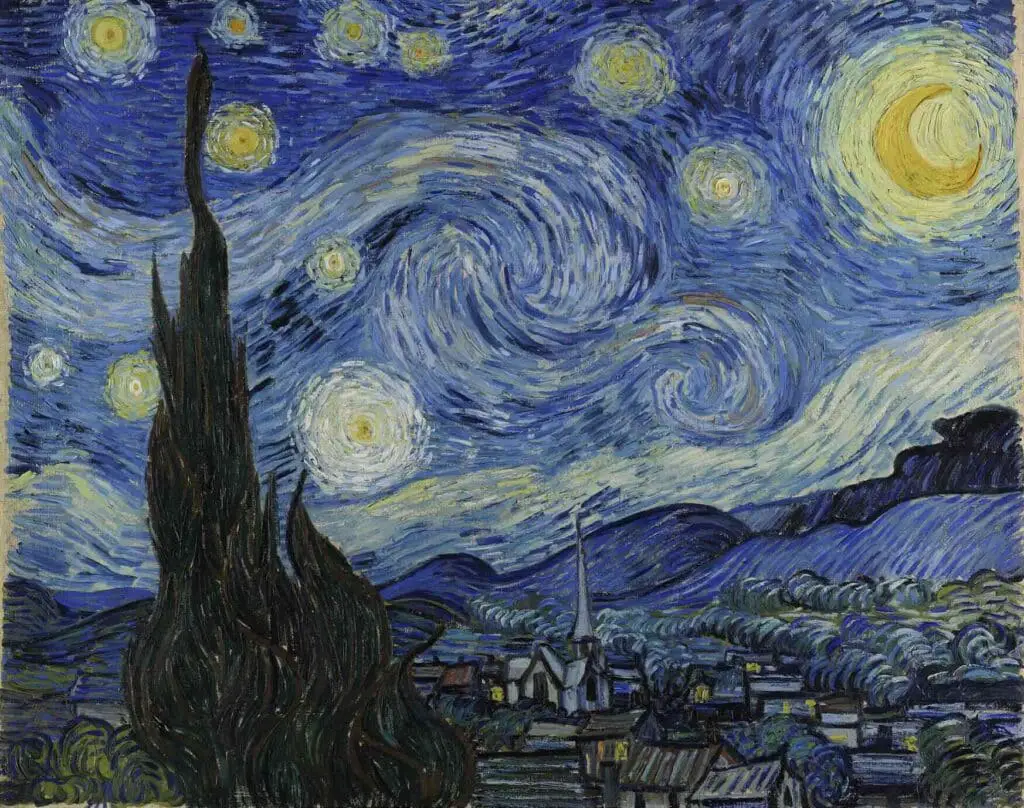
Vincent van Gogh’s Starry Night is more than just a painting—it is an icon, a visual poem, and a window into the mind of one of history’s most enigmatic artists. Swirling skies, radiant stars, and a mysterious village have captivated viewers for over a century, making it one of the most beloved works in the world. But beneath its beauty lies a fascinating story—a tapestry woven with emotion, mathematical precision, symbolism, and the struggles of Van Gogh’s own life.
Read on as we’ll journey through the hidden layers and little-known facts behind The Starry Night, exploring what makes it so extraordinary. From scientific discoveries to psychological insights, we’ll see why this painting continues to inspire awe and wonder.
Van Gogh’s Starry Night Origins: Painted in Isolation
In June 1889, Vincent van Gogh was living in the Saint-Paul-de-Mausole asylum in Saint-Rémy-de-Provence, France. The artist had suffered a series of mental breakdowns, including the infamous incident in which he cut off part of his ear. Seeking solace and treatment, he voluntarily entered the asylum, where he was confined but allowed to paint.
It was here, from a second-story window, that Van Gogh created The Starry Night. But the view was not as free as the painting suggests. Iron bars blocked his sight, and the landscape below was not exactly as depicted. Yet, in his isolation, Van Gogh found a way to transcend his physical limitations, painting a world that was as much about inner freedom as it was about the night sky.
1. The “Hidden” Mathematical Precision of Van Gogh’s Starry Night
The Fact
In 2004, physicists analyzing images from the Hubble Space Telescope discovered something astonishing: the swirling patterns in Van Gogh’s sky follow the Kolmogorov theory of turbulence—a complex mathematical principle describing how energy flows through fluids. This theory, formalized in 1941, explains the behavior of light and air in ways that are still being explored today.
Why It’s Important
Van Gogh created The Starry Night during a period of intense mental distress, yet he captured the physical behavior of the universe with uncanny accuracy. He painted the sky not as a static backdrop but as a living, breathing entity, its swirls echoing the hidden laws of nature. This suggests that, even in his so-called “madness,” Van Gogh possessed a supernatural intuition for the world’s order.
It’s a reminder that genius often exists on the edge of chaos. Van Gogh’s intuitive grasp of turbulence—a phenomenon not scientifically defined until decades after his death—shows how art and science can intersect in the most unexpected ways.

2. Van Gogh’s Starry Night Painted from a “Forbidden” View
The Fact
Van Gogh’s room in the asylum had a window, but it was barred with iron. The artist could see the hills and sky, but the bars obstructed his view. In The Starry Night, he deliberately omitted these bars, painting the landscape as if he were free to gaze upon it without restriction.
Why It’s Important
This choice transforms the painting from a simple landscape into a statement of psychological freedom. By removing the bars, Van Gogh was mentally escaping his confinement, rebelling against the limitations imposed on him. The painting becomes not just a depiction of what he saw, but an act of resistance—a manifestation of his desire to transcend his circumstances.
In this way, The Starry Night is a testament to the power of imagination. It shows how art can liberate us from the boundaries of reality, offering a space where the soul can roam free.
3. The Village: A Memory, Not a Reality
The Fact
While the hills and stars were visible from Van Gogh’s window, the village at the bottom of the painting was not. Many art historians believe the church spire is modeled after the architecture of his Dutch homeland, not the French countryside where he was staying.
Why It’s Important
This blending of elements confirms that The Starry Night is not an exercise in realism, but a work of Post-Impressionism. Van Gogh collaged memories from his past with his present surroundings, creating a landscape that bridges time and space. The painting is a visual diary, reflecting how he used art to connect his childhood in the Netherlands with his life in France.
It’s a powerful reminder of how art can serve as a bridge between worlds—between memory and reality, past and present. The village, a product of Van Gogh’s imagination, adds a layer of nostalgia and longing to the painting.
4. The Cypress Tree: A Symbol of Death
The Fact
The large, dark structure in the foreground of The Starry Night is a cypress tree. In Mediterranean culture, the cypress is a symbol of mourning and death, often planted in cemeteries.
Why It’s Important
The cypress tree acts as a bridge between the earth and the sky, reaching upward toward the swirling stars. Its presence is not accidental; Van Gogh was deeply influenced by the symbolism of the cypress, and he referenced it in his letters: “Just as we take the train to get to Tarascon or Rouen, we take death to reach a star.”
By placing the cypress so prominently, Van Gogh was contemplating mortality and the afterlife. The tree’s upward thrust suggests a journey—a passage from the earthly realm to the celestial. It adds a layer of existential depth to the painting, turning it into a meditation on life, death, and what lies beyond.
5. In Van Gogh’s Starry Night The “Morning Star” is Actually Venus
The Fact
Astronomers have mapped the night sky as it appeared in June 1889 and confirmed that the brightest white “star” in the painting, just to the right of the cypress tree, is actually the planet Venus.
Why It’s Important
This discovery shows that Van Gogh was a meticulous observer. Even in his stylized, swirling world, he tracked celestial bodies with such precision that modern scientists can verify the date he painted the sky. He wasn’t simply hallucinating or inventing; he was documenting the universe as he saw it.
Van Gogh’s attention to detail underscores the intersection of art and astronomy. It reminds us that artists are often keen observers of nature, capable of capturing truths that science later confirms. The presence of Venus adds a touch of realism to the painting, anchoring its dreamlike quality in the observable world.

6. Van Gogh Thought The Starry Night Was a Failure
The Fact
In letters to his brother Theo, Van Gogh referred to The Starry Night as a “study” and later wrote that it “says nothing to me.” He considered it a failure, believing the stars were too large and exaggerated.
Why It’s Important
This revelation offers a poignant glimpse into the mind of a genius. The work that the world considers Van Gogh’s greatest masterpiece was, in his own eyes, an unsuccessful attempt to capture the infinite beauty he felt. It’s a classic case of “imposter syndrome,” where the creator doubts the value of his own creation.
Van Gogh’s self-criticism reminds us that greatness is often accompanied by doubt. The gap between what he saw in his mind and what he could express on canvas was, for him, a source of frustration. Yet, it is precisely this struggle that gives The Starry Night its power—the sense of longing, the attempt to reach beyond the limits of human expression.
The Techniques: Swirls, Colors, and Brushwork Of Van Gogh’s Starry Night
Beyond the facts and symbolism, Van Gogh’s The Starry Night is a marvel of technique. Van Gogh’s use of color and brushwork is both bold and delicate, creating a sense of movement and energy.
The Swirls
The swirling patterns in the sky are perhaps the most distinctive feature. Van Gogh used thick, impasto brushstrokes, layering paint to create texture and depth. The movement of the swirls draws the eye across the canvas, suggesting wind, light, and cosmic energy.
The Colors
Van Gogh’s palette is dominated by blues and yellows, creating a contrast between the cool night and the warm glow of the stars. The colors are not naturalistic, but expressive—chosen to evoke emotion rather than replicate reality.
The Brushwork
The brushwork is dynamic and varied. Van Gogh applied paint with a sense of urgency, sometimes using the brush, sometimes the palette knife. The result is a surface that seems alive, vibrating with intensity.

The Emotions: Longing, Hope, and Despair
The Starry Night is not just a visual masterpiece—it is an emotional one. The painting reflects Van Gogh’s inner turmoil, his longing for peace, and his hope for transcendence.
Longing
The upward movement of the cypress and the swirling sky suggest a yearning for something beyond the earthly realm. Van Gogh was searching for meaning, for a connection to the infinite.
Hope
Despite the darkness, the painting is filled with light. The stars shine brightly, offering hope in the midst of despair. Van Gogh believed in the possibility of redemption, of finding beauty even in suffering.
Despair
The painting was created during a time of great distress. The sense of isolation and confinement is palpable, yet the painting transforms this despair into something beautiful—a testament to the power of creativity.
The Legacy: Why Vang Gogh’s Starry Night Matters
The Starry Night has become more than a painting—it is a cultural touchstone. It has inspired countless artists, musicians, and writers, and continues to captivate viewers around the world.
Artistic Influence
The painting is a cornerstone of Post-Impressionism, influencing generations of artists. Its bold colors and expressive brushwork pushed the boundaries of what painting could be.
Scientific Interest
The discovery of mathematical precision in the swirls has fascinated scientists, showing how art can anticipate scientific understanding.
Psychological Insight
Van Gogh’s struggle with mental illness has made The Starry Night a symbol of the connection between creativity and suffering. It offers hope to those who feel confined by their circumstances, showing that beauty can emerge from pain.

Little-Known Facts Recap Of Van Gogh’s Starry Night
Let’s recap the six little-known facts and why they matter:
- Mathematical Precision: Van Gogh intuitively captured the laws of turbulence, linking art and science.
- Forbidden View: He painted the landscape without the iron bars, symbolizing psychological freedom.
- Imaginary Village: The village blends memory and reality, bridging past and present.
- Cypress Symbolism: The tree represents death and the journey to the stars.
- Morning Star: Venus’s presence shows Van Gogh’s meticulous observation.
- Self-Doubt: Van Gogh considered the painting a failure, revealing the imposter syndrome of genius.
Vincent van Gogh’s Starry Night is a masterpiece not just for its beauty, but for the depth of its story. It is a painting born from isolation, shaped by longing, and infused with a sense of cosmic wonder. Its swirls capture the hidden laws of nature; its symbols speak of death and hope; its colors evoke emotion and transcendence.
But perhaps its greatest legacy is the reminder that art can bridge worlds—between science and imagination, memory and reality, despair and hope. Van Gogh’s struggles, his intuition, and his rebellion against confinement are all embedded in the canvas, making The Starry Night a timeless expression of the human spirit.
As we gaze upon the painting, we are invited to see not just the night sky, but the universe within ourselves—a place where beauty and suffering coexist, and where creativity can transform even the darkest night into a star-filled wonder.
Starry Night is more than a painting—it is a story, a science, and a soul. And its light continues to shine, guiding us through the mysteries of art, life, and the universe.
Additional Information On Van Gogh’s Starry Night Painting
Here is some additional information on Van Gogh’s Starry Night Painting.
- Why Does Van Gogh’s Starry Night Still Captivate Us Today? To learn more click here.
- The Starry Night Sky – Iconic Vincent Van Gogh Painting Discover more by clicking here.
- The Starry Night Original By Vincent Van Gogh Read more by clicking here.
- How Much Is Van Gogh’s Starry Night Worth, And Other Facts To discover more read out blog by clicking here.
Deep Dive Podcast On Van Gogh’s Starry Night
Learn more about Van Gogh’s Starry Night by listening to our podcast.
Anita Louise Art is dedicated to art education, great artists, and inspiring others to find and create their art. We love art that uplifts and inspires. #ArtToMakeYouSmile! #ArtToMakeYouHappy!
If you want to see any of my art, you can find out more by clicking here. If you are interested in what inspires me and my paintings, you can discover more by clicking here.
We have a free newsletter and would love you to be part of our community; you can subscribe to the newsletter by clicking here. If you have any questions, I would be happy to talk to you anytime. You can reach me, Anita, by clicking here.
Subscribe to our Anita Louise Art YouTube Channel with great videos and information by clicking here.
Join us for our podcast “5 Minutes With Art or Deep Dive with 5 Minutes With Art” Spend just a few minutes a week with us to discover and learn about great art and artists. You can find out more about our podcast by clicking here.
Related Questions
The Myth of the Tortured Artist: Is Suffering the Secret Ingredient to Greatness?
There is a persistent, almost seductive belief in the art world: that to create truly profound work, an artist must first be broken. We have romanticized the “starving artist” and the “mad genius” to the point where we sometimes wonder if stability is the enemy of creativity. But is this true? Is suffering actually a prerequisite for greatness, or is the “Tortured Artist” a myth that does more harm than good?
The Myth of the Tortured Artist: Is Suffering the Secret Ingredient to Greatness? Click here to learn more.
Van Gogh Color Symbolism: The Secret Language of Yellow and Blue and What It Reveals About the Human Soul
If you were to close your eyes and think of the name “Vincent van Gogh,” what do you see? Chances are, it isn’t just a face with a red beard. It’s a vivid display of Van Gogh Color Symbolism—a collision of colors that define his art: the searing, almost blinding yellow of a sunflower set against a swirling, deep-midnight blue. These iconic hues are more than aesthetic choices; they embody the emotional depth and creative vision that make Van Gogh’s work so unforgettable.
Van Gogh Color Symbolism: The Secret Language of Yellow and Blue and What It Reveals About the Human Soul Click here to discover more.
Katsushika Hokusai: The “Old Man Mad About Drawing” Who Changed the World
We often think of “influencers” as a modern phenomenon, but Katsushika Hokusai proves that true influence transcends time and technology. In the 19th century, Katsushika Hokusai was the biggest influencer in the art world—not with a smartphone, but with a woodblock, a bowl of Prussian Blue ink, and a spiritual obsession with a mountain. His groundbreaking work continues to inspire artists and admirers around the globe.