
When modern audiences look at traditional Japanese woodblock prints—known worldwide as ukiyo-e—they often see exquisite museum pieces preserved under protective glass. We marvel at the sweeping turquoise crest of Katsushika Hokusai’s The Great Wave off Kanagawa, the deliberate, theatrical grimaces of Toshusai Sharaku’s kabuki actors, or the delicate, elongated courtesans painted by Kitagawa Utamaro.
Yet viewing these masterworks solely as fine art obscures their real origins. Japanese woodblock prints were not created for quiet contemplation in elite galleries. They were born as mass-market commercial products, fashion magazines, celebrity pin-ups, travel advertisements, and political satire.
Why Did the Japanese Create Woodblock Prints? The Untold Story of Ukiyo-e
To understand why the Japanese developed the woodblock print during the Edo period (1603–1867), you have to look past aesthetics and dive into the explosive collision of political isolation, rigid social hierarchies, an ascendant merchant class, and the hedonistic subculture of the “Floating World.”
1. The Peace of the Tokugawa Shogunate: The Spark for Urban Culture and Japanese Woodblock Prints
To explain why Japanese woodblock prints appeared in the 17th century, one must first look at the political settlement that preceded them. For more than a century during the Sengoku period (the “Age of Warring States”), Japan had been consumed by perpetual civil war. Samurai clans clashed across the archipelago, castles burned, and life was precarious.
That brutal era ended abruptly in 1603, when Tokugawa Ieyasu unified the country, seized total military control as Shogun, and established his military government in a modest marshland fishing village called Edo (modern-day Tokyo).
The Tokugawa Shogunate introduced two revolutionary policies that permanently transformed Japanese society:
The Sankin-kōtai System (Alternate Attendance)
To prevent regional warlords (daimyo) from amassing enough money or military might to stage a rebellion, the Shogunate forced them to maintain lavish estates in Edo and reside there every other year. When a lord returned to his home province, his wife and heir had to remain behind in Edo as virtual political hostages.
This policy triggered massive economic centralization. Tens of thousands of samurai, bureaucrats, retainers, and craftsmen poured into Edo to support the warlords’ estates. Within a century, Edo grew into a sprawling metropolis of over one million residents—surpassing both London and Paris to become the largest city in the world.
Sakoku (National Seclusion)
Beginning in the 1630s, the Shogunate closed Japan’s borders to the outside world. Travel abroad was punished by death, foreign books were heavily restricted, and European traders were expelled (with the sole exception of a heavily monitored Dutch trading post on the artificial island of Dejima in Nagasaki).
Cut off from foreign trade and external cultural currents, domestic culture turned inward. Japan spent 250 uninterrupted years in peacetime isolation. Without wars to fight, money and energy shifted toward urban commerce, leisure, domestic travel, and entertainment.
2. The Merchant Dilemma: Rich in Coin, Poor in Status
The social architecture of Edo Japan was rigidly organized under a Confucian moral framework called Shinōkōshō, which divided society into four strict, hereditary classes:
| Class Rank | Group | Confucian Rationale | Economic Reality in Edo |
| 1. Highest | Samurai (Shi) | Governed society, maintained honor, held administrative power | Lived on fixed rice stipends; frequently sank into debt |
| 2. Second | Peasants/Farmers (Nō) | Produced the food that sustained human life | Heavily taxed; lived subsistence lifestyles |
| 3. Third | Artisans (Kō) | Crafted physical goods, tools, and structures from raw materials | Modest living; respected for physical craft |
| 4. Lowest | Merchants (Shō) | Produced nothing of their own; profited merely by moving goods | Amassed enormous cash wealth through urban trade |
This structure created a massive social contradiction. The merchants (chōnin, or “townspeople”) sat at the absolute bottom of the moral hierarchy. Yet as Edo’s market economy exploded, these brokers, sake brewers, pawnbrokers, and textile traders amassed immense fortunes.
Conversely, the samurai at the top of the social ladder lived on fixed rice stipends. When the price of rice fell or living costs rose, proud samurai were forced to borrow money from the very merchants they looked down upon.
Sumptuary Laws and Secret Luxuries
The Tokugawa Shogunate was terrified by this shift in financial power. To keep the newly wealthy merchants in their place, the government passed sweeping sumptuary laws. These decrees dictated:
- What fabrics merchants could wear (banning silk, allowing only rough cotton and hemp).
- What architecture they could build (limiting gate sizes and house heights).
- What foods they could serve at weddings.
Merchants were legally forbidden from displaying ostentatious wealth. They could not buy estates, construct lavish gardens, or parade around like samurai aristocrats.
So, where did their mountains of disposable income go? It flowed directly into ephemeral, consumable pleasure: the theater, the teahouses, the restaurants, the pleasure quarters—and mass-produced art they could enjoy inside their private homes.

3. The Philosophy of Ukiyo: From Buddhist Grief to Urban Hedonism and Japanese Woodblock Prints
The word ukiyo originally came from a Buddhist concept written as 憂き世, meaning “sorrowful world” or “transient, painful realm.” Classical Japanese Buddhism taught that worldly existence was brief, fragile, and defined by suffering; spiritual salvation required detaching oneself from earthly illusions.
During the Edo peace, urban townspeople turned this concept on its head. They swapped the kanji character for “sorrowful” (憂) with a homophone meaning “floating” (浮).
The new word—ukiyo (浮世), or the “Floating World”—no longer meant resigning oneself to worldly misery. It meant leaning completely into life’s fleeting pleasures.
The spirit of this transformation was immortalized in 1661 by the popular writer Asai Ryōi in his preface to Tales of the Floating World (Ukiyo Monogatari):
“Living only for the moment, turning our full attention to the pleasures of the moon, the snow, the cherry blossoms and the maple leaves; singing songs, drinking sake, diverting oneself merely in floating, floating, caring not a whit for the poverty staring us in the face, refusing to be disheartened, like a gourd floating along with the river current: this is what we call the floating world.”
Tales of the Floating World (Ukiyo Monogatari)
The Japanese created ukiyo-e (“pictures of the floating world”) to chronicle, advertise, and celebrate this exact countercultural lifestyle.
4. What Did the Japanese Woodblock PrintsActually Depict? The Core Genres
Woodblock prints did not emerge from a vacuum; they answered specific consumer demands in Edo, Kyoto, and Osaka. Publishers developed discrete genres to satisfy the public’s insatiable appetite for urban culture:
1. Yakusha-e (Kabuki Actor Prints): The Movie Posters of the 18th Century
Kabuki theater was the beating heart of Edo popular entertainment. It was loud, flamboyant, sensory, and common—the direct opposite of the austere, elite Noh theater favored by the samurai class.
Commoners obsessed over celebrity kabuki actors like Ichikawa Danjūrō. Fans wanted memorabilia, programs, and portraits of their idols in famous dramatic roles. Print publishers churned out yakusha-e by the tens of thousands.
Artists like Katsukawa Shunshō and the enigmatic Sharaku captured dynamic stage poses (mie), characterized by dramatic grimaces and crossed eyes. Theatergoers bought these single-sheet prints immediately after the curtain fell, taking home a tangible piece of the performance.
2. Bijin-ga (Pictures of Beautiful Women): Fashion and Celebrity Pin-Ups
The licensed pleasure quarter of Edo—known as the Yoshiwara—was an enclosed city-within-a-city surrounded by walls and a moat. Within its gates lived high-ranking courtesans (oiran and tayū) who were revered as trendsetters, style icons, and artists in poetry, calligraphy, and music.
Ordinary townspeople could never afford to meet a top-tier courtesan, but for the price of a bowl of noodles, they could buy a bijin-ga print by Kitagawa Utamaro.
These prints operated just like modern high-fashion glossies. They showed the public:
- The newest, most intricate kimono patterns.
- Elaborate seasonal hairpins (kanzashi) and complex coiffures.
- Modern cosmetic trends (such as applying green iridescent lip glaze or shaving eyebrows).
3. Meisho-e (Landscape and Travel Prints): Tourism and Domestic Escapism
For ordinary Japanese citizens under Tokugawa rule, personal freedom of movement was strictly regulated. Citizens were forbidden from traveling freely between provinces without official barrier passes issued by the government.
There was, however, one major legal loophole: religious pilgrimage.
Commoners routinely obtained travel permits to visit sacred sites like the Grand Shrine of Ise, Mount Fuji, or Mount Kotohira. As roads like the Tōkaidō (connecting Edo and Kyoto) filled with inns, tea stalls, and shrines, a vibrant tourism industry erupted.
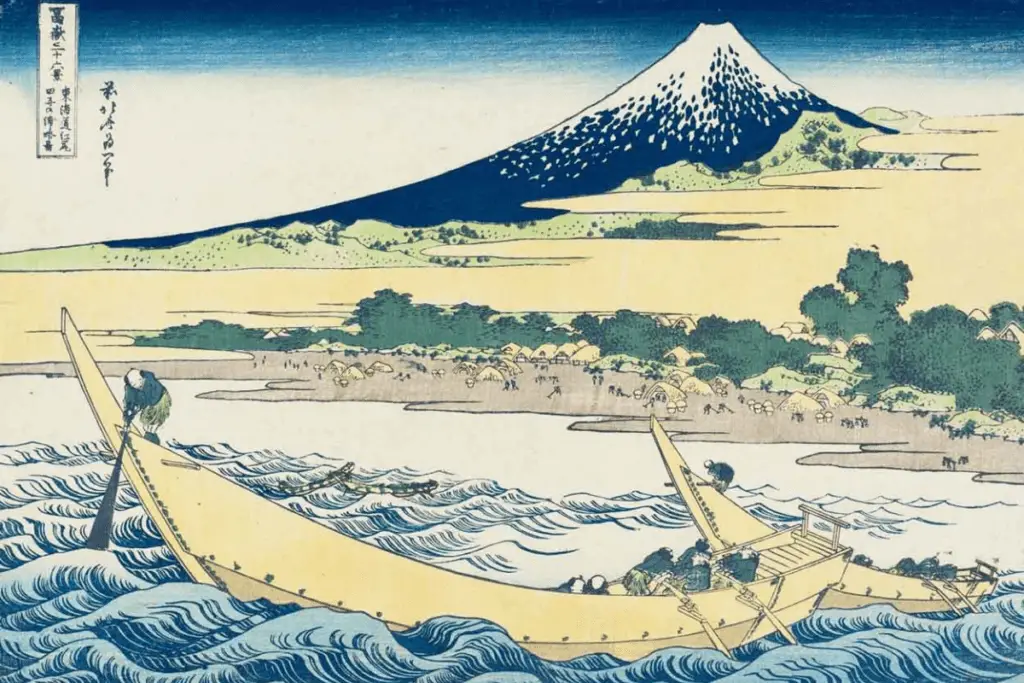
Publishers seized on this wanderlust. When Hokusai released his legendary Thirty-Six Views of Mount Fuji (c. 1830–1832) and Utagawa Hiroshige published The Fifty-Three Stations of the Tōkaidō (1833–1834), they created the world’s first mass travel souvenirs.
Pilgrims bought them to plan their journeys, travelers took them home as souvenirs for friends, and those stuck working in Edo bought them for pure armchair escapism.
4. Shunga (Erotic Prints) and Japanese Woodblock Prints
No exploration of ukiyo-e is honest without mentioning shunga (“spring pictures”). Erotic imagery made up a substantial portion of print production, created by nearly every major master, including Hokusai, Utamaro, and Harunobu.
Far from being hidden in shame, shunga prints were widely circulated among both men and women across all social strata. They were tucked into bridal dowries as sex education guides, used as talismans by samurai to ward off death in battle, and read as entertainment by urban townspeople.
5. The Manufacturing Engine: The Woodblock Quartet
A common Western myth is that a woodblock print was the work of a single, solitary artist. In reality, ukiyo-e production was an industrial, four-way collaboration between distinct commercial specialists.
The entire process was overseen by a commercial entrepreneur who took on the financial risk:

The Publisher (Hanmoto)
The publisher was the engine of the entire enterprise. Figures like Tsutaya Jūzaburō were the media moguls of the Edo era. The publisher scouted talent, evaluated street trends, secured paper and pigment supplies, funded the project, and navigated the strict government censors. If a print sold out, the publisher made a fortune; if it violated sumptuary laws, the publisher was fined, chained, or banished.
The Artist (Eshi)
The master artist—whether Hiroshige, Hokusai, or Utamaro—rarely touched wood or carving chisels. The artist was commissioned by the publisher to produce a single, black-ink master outline drawing (hanshita-e) on thin Japanese paper. Once submitted, the artist’s direct physical role in the printing was complete.
The Block Cutter (Horishi)
The block cutter was a craftsman of astonishing precision. The master drawing was glued face-down directly onto a plank of seasoned, hard mountain cherry wood (yamazakura).
The carver chiseled away the negative space between the drawn lines, destroying the original drawing in the process to create the raised key block (omohan). The carver then helped create secondary blocks for every single color tone, carving distinct registration marks (kento) into the corners of each woodblock to ensure the colors aligned perfectly during printing.
The Printer (Surishi)
The printer required profound physical sensitivity. Working with water-based pigments (derived from plants, minerals, and later imported synthetic dyes like Prussian blue) mixed with rice flour paste (nori), the printer applied color to the damp woodblock using horsehair brushes.
A sheet of handmade washi paper (often derived from the inner bark of the kozo mulberry tree) was placed over the block. Using a circular, bamboo-sheathed hand pad called a baren, the printer applied rhythmic body pressure in circular motions to force the pigment deep into the fibers of the paper. For complex multi-color prints (nishiki-e), this process had to be repeated dozens of times with absolute registration accuracy.
6. Censorship, Satire, and Survival: The JapaneseWoodblock Prints Fight Back
Because Japanese Woodblock Prints reached thousands of citizens within days, the Shogunate viewed them with deep suspicion. The government saw ukiyo-e as a hotbed of moral corruption, unauthorized political commentary, and bourgeois insolence.
Periodically, conservative Shogunate reformers instituted purges:
- The Kansei Reforms (1790s): Banned luxury prints, prohibited identifying courtesans by name, and instituted mandatory censorship seals (kiwame) stamped on every approved print.
- The Tenpō Reforms (1841–1843): Chief senior councilor Mizuno Tadakuni launched a draconian assault on commoner culture. Kabuki theaters were forced out of central Edo, prints of geishas and actors were banned outright, and publishers were forbidden from using more than seven or eight simple colors per print.
How Artists Outsmarted the Censors and Japanese Woodblock Prints
Rather than destroying woodblock prints, censorship forced artists to become radically creative:
- Puns and Riddles (Mitate): When forbidden from painting famous actors, artists disguised them as historical heroes, mythical demons, or ordinary shopkeepers. Edo audiences loved visual riddles and easily decoded the inside jokes.
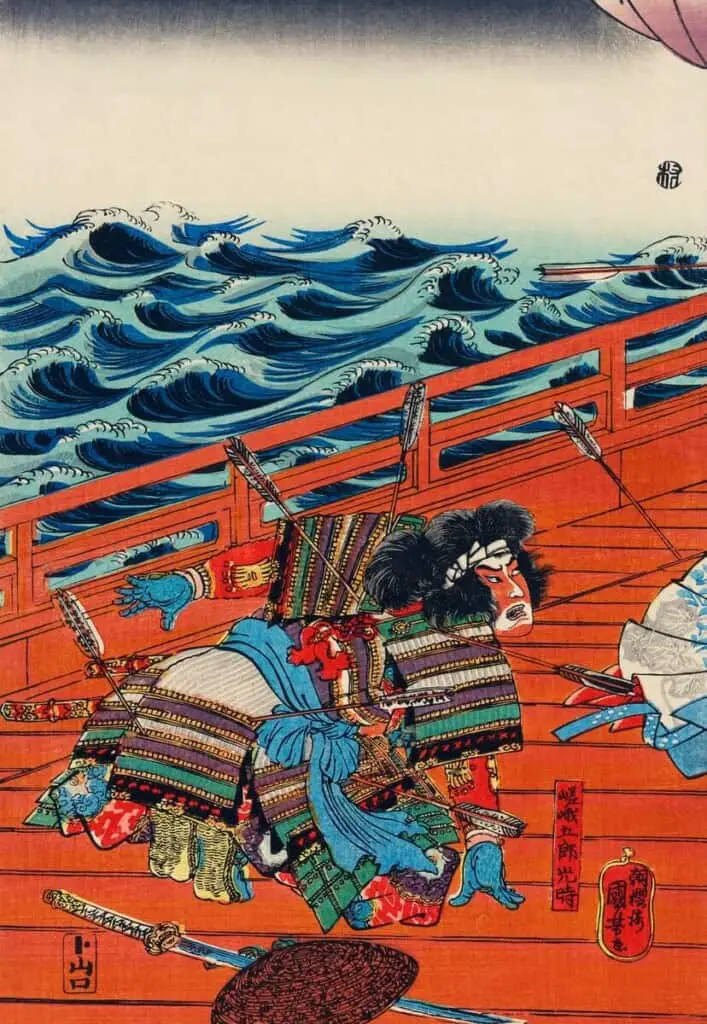
- Anthropomorphic Satire: Master artist Utagawa Kuniyoshi became a legend by dressing forbidden actors and corrupt political officials as cats, sparrows, goldfish, and monsters. When censors challenged him, Kuniyoshi maintained that he was simply painting funny animals.
The cat-and-mouse game between artists and the Shogunate proved how central woodblock prints had become: they were not merely decorative pictures, but the uncensored nervous system of Edo’s public discourse.

7. The Technological Leap: From Single Line to Brocade
Woodblock printing was not invented in Edo; it had been imported from China centuries earlier to reproduce Buddhist sutras and religious texts. But Japan transformed a monochromatic, literary technology into the world’s most advanced polychrome color-printing system.
The evolution moved through four distinct technical phases:
- Sumizuri-e (c. 1670s–1710s): Monochrome prints produced using only black sumi ink, pioneered by artists like Hishikawa Moronobu. If color was present, it had to be painted in by hand after printing.
- Benizuri-e (c. 1740s): Two- or three-color printing, using red vegetable dyes (beni) and pale greens or yellows.
- Nishiki-e (“Brocade Prints”, 1765): The monumental breakthrough attributed to Suzuki Harunobu. By using precise corner registration marks (kento), Harunobu successfully layered ten to twenty distinct color blocks onto a single sheet of paper without misaligning the colors. The resulting prints resembled woven silk brocade, launching the golden age of ukiyo-e.
- The Prussian Blue Revolution (1830s): Prior to 1830, blues derived from dayflower or indigo were dull and faded quickly under light. The commercial import of synthetic Prussian blue (bero-ai) from Europe gave Japanese artists access to an intense, lightfast, deep blue. It was this pigment that made Hokusai’s The Great Wave and Hiroshige’s atmospheric rainscapes technically possible.
8. The Sunset of Ukiyo-e and the Global Aftershock
In 1853, American Commodore Matthew Perry steamed four modern war frigates into Tokyo Bay, forcing Japan to end its two-century isolation and sign unequal trade treaties with the West.
The Tokugawa Shogunate collapsed in 1867, giving way to the Meiji Restoration. Japan industrialized overnight, desperate to modernize and avoid Western colonization:
- Gas streetlights and telegraph lines replaced paper lanterns and post couriers.
- Metal moveable-type printing presses and imported chemical dyes arrived.
- Photography emerged, making hand-carved actor portraits and travel prints obsolete practically overnight.
Within thirty years of Japan’s opening, traditional ukiyo-e had collapsed as a domestic commercial industry. The prints were considered outdated relics in their homeland, discarded as cheap wrapping paper for exported ceramics and porcelain.

The Western Discovery: Japonisme
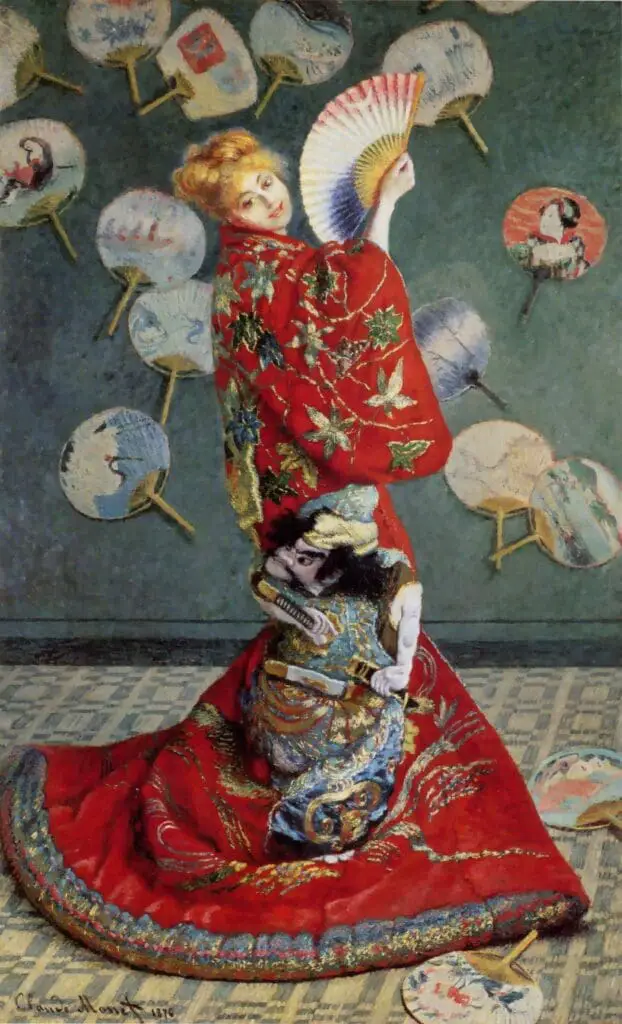
When those wrapped ceramics arrived in Paris, London, and Amsterdam, European artists uncovered the discarded prints and were thunderstruck.
Painters like Vincent van Gogh, Claude Monet, Edgar Degas, and Henri de Toulouse-Lautrec were suffocating under the rigid rules of the Western academic tradition. In Japanese woodblock prints, they discovered a radical visual revolution:
- High, tilted horizons instead of rigid linear perspective.
- Unapologetic graphic outlines and flat planes of pure color.
- Radical, asymmetrical compositions and dramatic foreground cropping.
Van Gogh spent his scarce funds collecting hundreds of Japanese prints, copying them stroke-for-stroke in oil, and declaring that all modern art must learn from their directness. What began as disposable pop-culture ephemera for merchants in Edo became the spark that ignited European Modern Art.
The True Spirit of Japanese Woodblock Prints
Why did the Japanese create woodblock prints?
They created them because an urban population found itself with wealth it was forbidden to spend, status it was forbidden to hold, and an unquenchable thirst to see its own modern life reflected in vivid color.
They were created to satisfy an appetite for heroes and beauties, to advertise fabrics and noodle houses, to mock stuffy politicians from behind a mask of cats and demons, and to allow an ordinary laborer to hold a view of Mount Fuji in his hands for the cost of lunch.
Far from being quiet relics of an ancient era, Japanese woodblock prints were the electric, commercial, subversive mass media of an isolated world—celebrating life not because it lasted forever, but precisely because it was destined to float away.
Anita Louise Art is dedicated to art education, great artists, and inspiring others to find and create their art. We love art that uplifts and inspires. #ArtToMakeYouSmile! #ArtToMakeYouHappy!
If you want to see any of my art, you can find out more by clicking here. If you are interested in what inspires me and my paintings, you can discover more by clicking here.
We have a free newsletter and would love you to be part of our community; you can subscribe to the newsletter by clicking here. If you have any questions, I would be happy to talk to you anytime. You can reach me, Anita, by clicking here.
Subscribe to our Anita Louise Art YouTube Channel with great videos and information by clicking here.
Join us for our podcast “5 Minutes With Art or Deep Dive with 5 Minutes With Art” Spend just a few minutes a week with us to discover and learn about great art and artists. You can find out more about our podcast by clicking here.
Related Questions
The Myth of the Tortured Artist: Is Suffering the Secret Ingredient to Greatness?
There is a persistent, almost seductive belief in the art world: that to create truly profound work, an artist must first be broken. We have romanticized the “starving artist” and the “mad genius” to the point where we sometimes wonder if stability is the enemy of creativity. But is this true? Is suffering actually a prerequisite for greatness, or is the “Tortured Artist” a myth that does more harm than good?
The Myth of the Tortured Artist: Is Suffering the Secret Ingredient to Greatness? Click here to learn more.
Van Gogh Color Symbolism: The Secret Language of Yellow and Blue and What It Reveals About the Human Soul
If you were to close your eyes and think of the name “Vincent van Gogh,” what do you see? Chances are, it isn’t just a face with a red beard. It’s a vivid display of Van Gogh Color Symbolism—a collision of colors that define his art: the searing, almost blinding yellow of a sunflower set against a swirling, deep-midnight blue. These iconic hues are more than aesthetic choices; they embody the emotional depth and creative vision that make Van Gogh’s work so unforgettable.
Van Gogh Color Symbolism: The Secret Language of Yellow and Blue and What It Reveals About the Human Soul Click here to discover more