
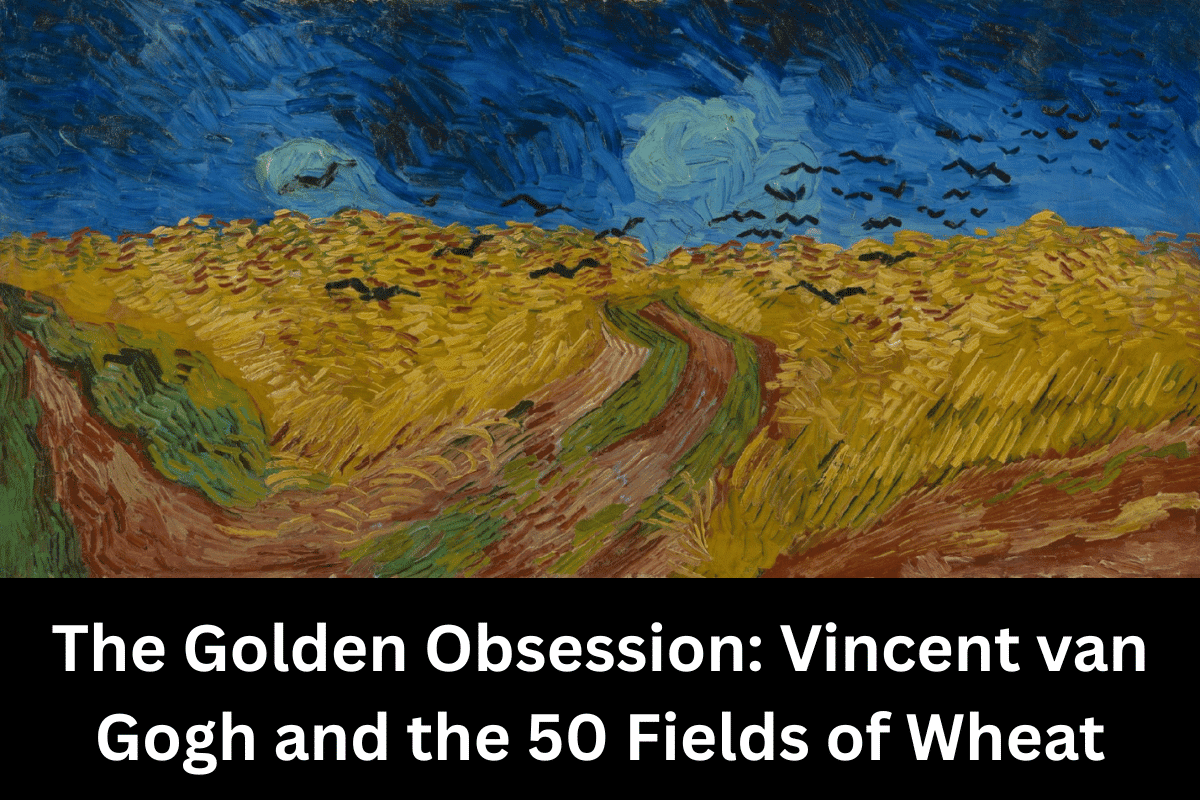
Vincent van Gogh’s life and work are a testament to the power of creativity, resilience, and the relentless pursuit of artistic expression.
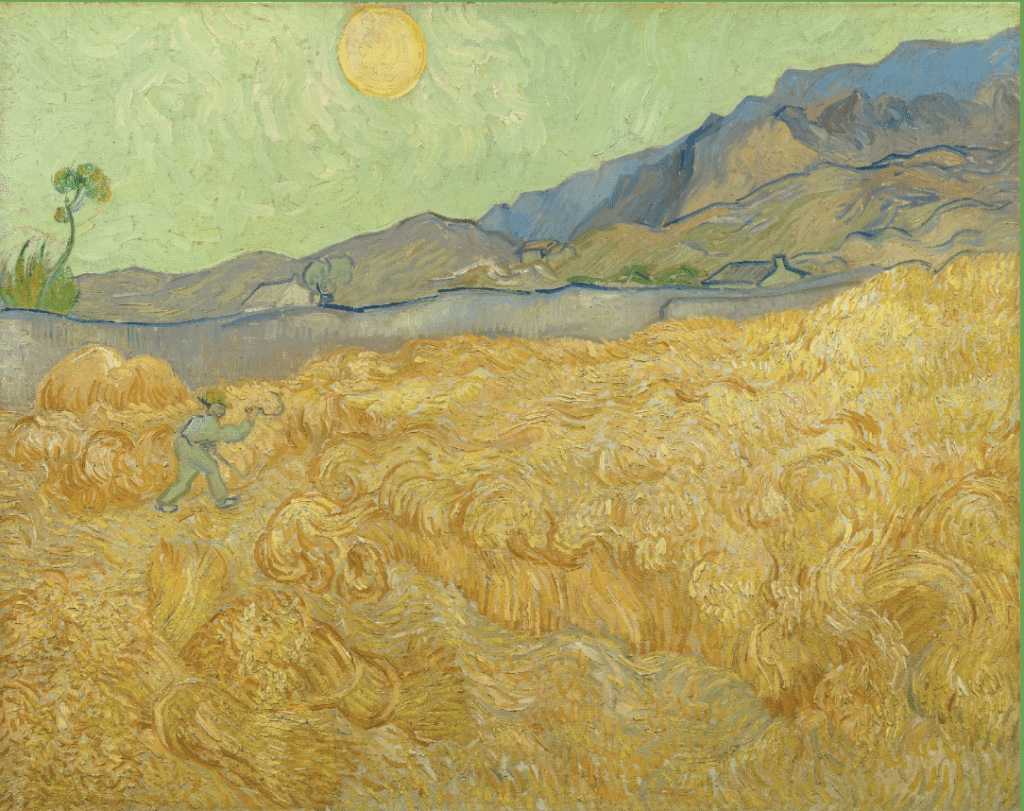
Among his many masterpieces, the painting Wheatfield (created in Arles, June 1888) stands as a vivid representation of his connection to nature, his innovative techniques, and his emotional intensity.
Table of Contents
- 🎨 Key Takeaways: Van Gogh’s Golden Obsession
- The Artist Obsessed: 50 Fields of Gold
- The Life of Vincent van Gogh: A Brief Overview
- Deep Dive Podcast
- Related Questions
🎨 Key Takeaways: Van Gogh’s Golden Obsession
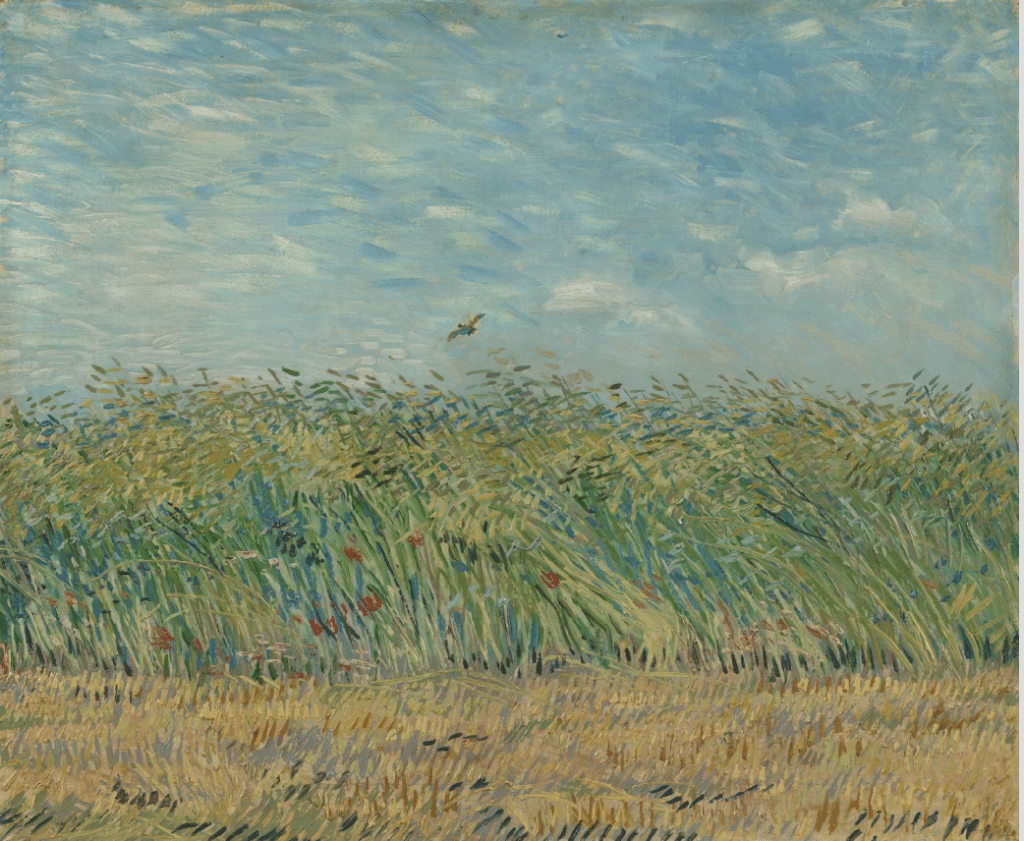
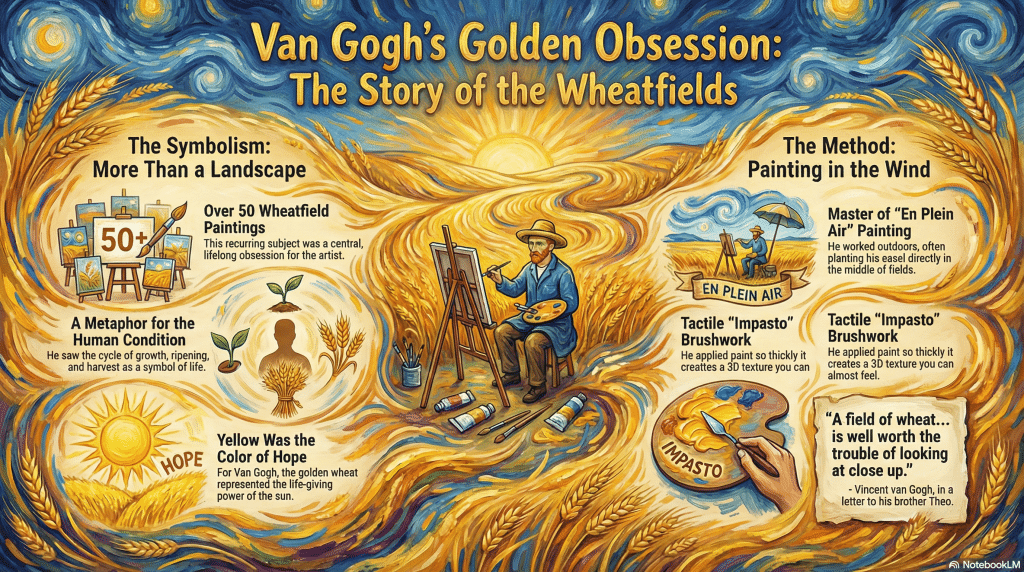
- A Lifelong Theme: Scholars believe Van Gogh painted over 50 distinct wheatfield scenes, making it one of the most recurring and significant subjects of his career.
- Immersion Over Observation: He was a master of en plein air painting, often pinning his easel into the ground in the middle of a field to capture the wind and light in real-time.
- The Feel of the Wind: Because he painted from within the stalks, his signature “impasto” (thick) brushwork allows viewers to almost feel the physical movement of the wheat.
- Symbol of Vitality: For Van Gogh, the golden wheat was more than just a landscape—it was a powerful symbol of the cycle of life, growth, and the energy of nature
The Artist Obsessed: 50 Fields of Gold
While many associate Van Gogh with sunflowers or starry nights, his true, enduring obsession was the wheatfield. He didn’t just paint them occasionally; he returned to them with a religious fervor. Today, art scholars believe Van Gogh painted over 50 distinct wheatfield scenes during his career.
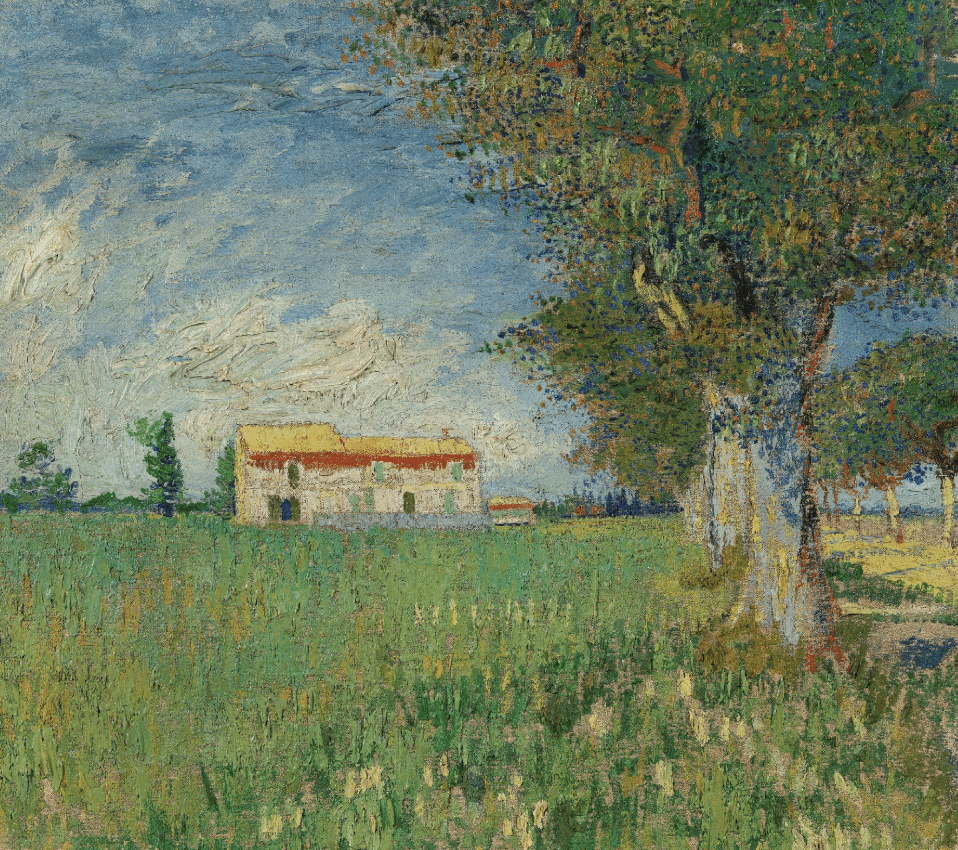
He was a painter who deeply loved the cycle of the harvest, seeing in the wheat a metaphor for the human condition—growth, ripening, and eventually, the reaper. This was not a passing interest, but a central theme that he explored across Arles, Saint-Rémy, and Auvers-sur-Oise.
The Life of Vincent van Gogh: A Brief Overview
Born in the Netherlands in 1853, Vincent van Gogh is one of the most celebrated artists in history, yet his life was marked by struggle and mental illness. He produced over 2,000 artworks in just over a decade. Despite this prolific output, he lived in relative obscurity, selling only one painting during his lifetime.
Once he dedicated himself to art at age 27, his passion became all-consuming. His style evolved from somber depictions of laborers to the vibrant, expressive brushwork for which he is now world-renowned. In 1888, seeking the “high yellow” light of the sun, he moved to Arles in the south of France, where his obsession with the golden landscape reached its peak.
Standing in the Wind: The En Plein Air Experience
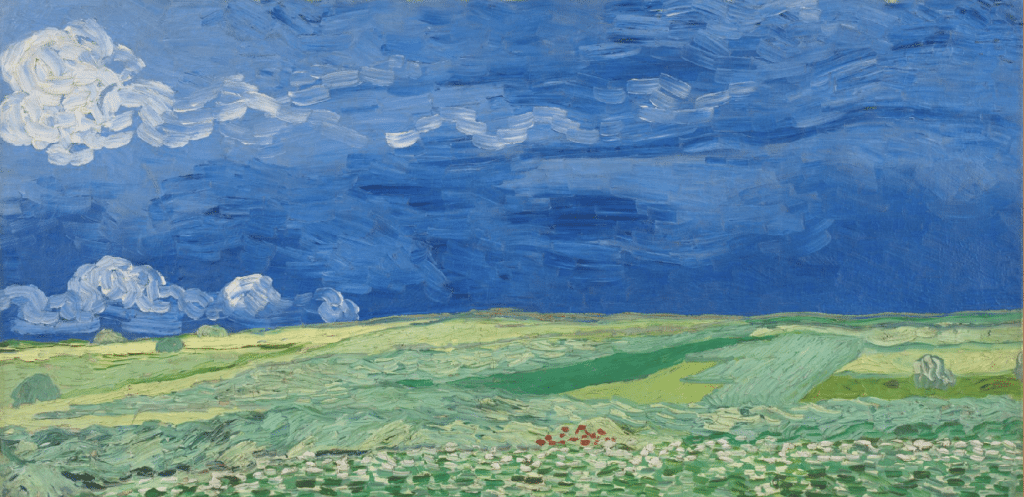
Van Gogh was not a studio artist who painted from memory; he was a man of the earth. He was a dedicated practitioner of en plein air (painting outdoors), which meant he would carry his heavy easel, canvases, and paints directly into the middle of the fields.
“What a joy it is to paint outdoors, to be in direct contact with nature. The wheatfields are magnificent, and the colors are so vibrant. It’s as if the earth itself is alive with energy.” — Vincent van Gogh to his brother, Theo.
He would get up close and personal with his subjects, often planting his easel in the thick of the stalks.
To combat the fierce Mistral winds of Provence, he would sometimes have to pin his easel into the ground to keep it from blowing over. In June 1888, he wrote to his friend Émile Bernard about how he managed to stay upright:
“My easel was fixed in the ground with iron pegs, a method that I recommend to you. You shove the feet of the easel in and then you push a 50-centimeter-long iron peg in beside them. You tie everything together with ropes; that way you can work in the wind.” Vincent Van Gogh to his friend Emile Bernard
Because he was physically standing in the center of the field while painting, you can almost feel the wheat in the wind when you look at his canvases.
To his brother Theo he also wrote about the wheatfields.
“A field of wheat… is well worth the trouble of looking at close up.” Vincent Van Gogh to his brother Theo.
The frantic, rhythmic strokes aren’t just artistic choices; they are a direct recording of the swaying movement he was experiencing in real-time.
Analyzing the 1888 Wheatfield
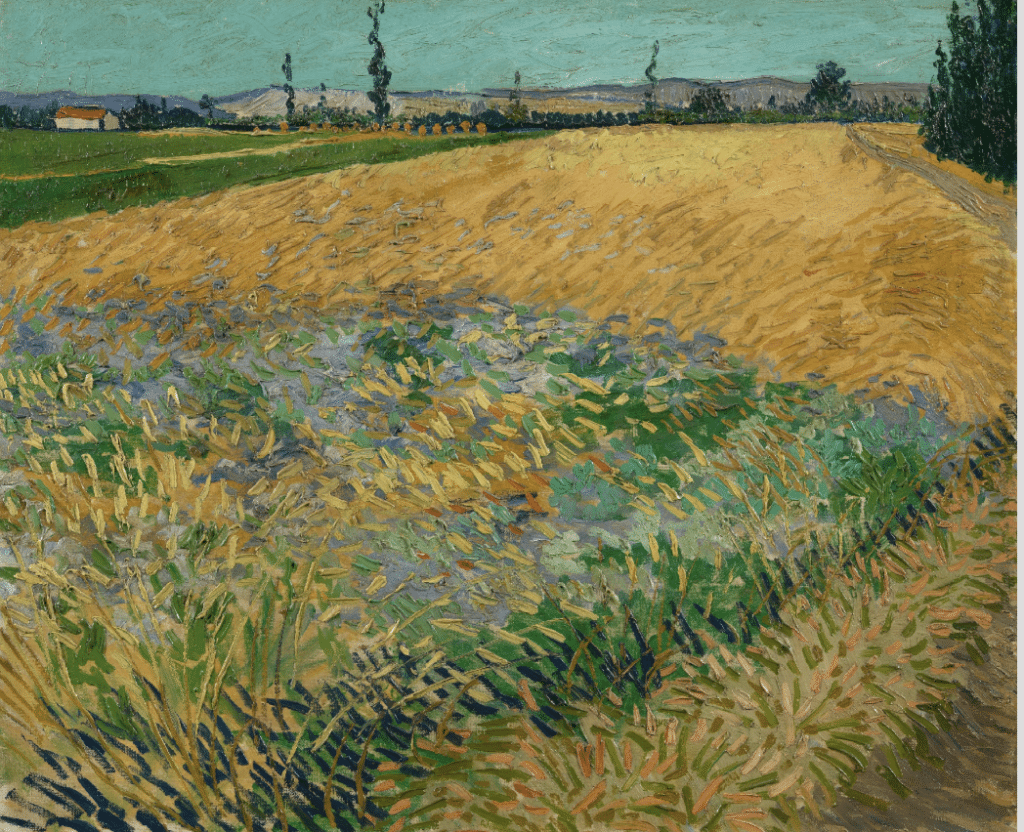
One of Van Goghs more famous Wheatfields is his wheatfield of June 1888. Here are some reasons why.
Composition and Perspective
One of the most striking features of the Arles Wheatfield is its composition. The horizon sits unusually high, which forces the viewer’s eye downward into the grain. By putting himself (and the viewer) low to the ground, he creates an intimate connection that makes the field feel infinite.
Brushwork and “Impasto”
Van Gogh’s brushwork is dynamic and tactile. He used a technique called impasto, applying paint so thickly that it stands off the canvas in ridges. This gives the painting a three-dimensional quality—up close, the strokes appear as chaotic swirls, but from a distance, they resolve into a shimmering, golden sea.
The Symbolic Palette
For Vincent, yellow was the color of hope, warmth, and the life-giving power of the sun. In this 1888 version, the “old gold” of the wheat is punctuated by hints of green and blue, capturing the peak of summer heat and the vitality of the harvest.
A Timeless Legacy
Although Van Gogh’s life was tragically short—dying in 1890 at age 37—his impact is immeasurable. Wheatfield is a testament to his ability to find divinity in the everyday. It serves as a reminder that even in the face of personal adversity, one can find solace and meaning in the natural world.
To stand before a Van Gogh wheatfield is to step into his world—to feel the heat of the sun, the rustle of the wind, and the hum of life. As we gaze upon these shimmering masterpieces, we are reminded of his courage:
“What would life be if we had no courage to attempt anything?”
Deep Dive Podcast
Check out our Deep Dive Podcast
Anita Louise Art is dedicated to art education, great artists, and inspiring others to find and create their art. We love art that uplifts and inspires. #ArtToMakeYouSmile! #ArtToMakeYouHappy!
If you want to see any of my art, you can find out more by clicking here. If you are interested in what inspires me and my paintings, you can discover more by clicking here.
We have a free newsletter and would love you to be part of our community; you can subscribe to the newsletter by clicking here. If you have any questions, I would be happy to talk to you anytime. You can reach me, Anita, by clicking here.
Subscribe to our Anita Louise Art YouTube Channel with great videos and information by clicking here.
Join us for our podcast “5 Minutes With Art or Deep Dive with 5 Minutes With Art” Spend just a few minutes a week with us to discover and learn about great art and artists. You can find out more about our podcast by clicking here.
Related Questions
Pulling Back the Curtain: Women Artists of the Baroque Era Who Shattered Conventions
The names Caravaggio, Bernini, and Rubens dominate the narrative, celebrated as the geniuses who defined one of art’s most theatrical and emotive periods. But what if that picture is incomplete? What if, hidden behind the shadows of these towering figures, there were women whose contributions were equally groundbreaking yet overlooked by history?
You can read Pulling Back the Curtain: Women Artists of the Baroque Era Who Shattered Conventions by clicking here.
Where Did The Renaissance Begin? Why It Was Essential
The Renaissance began in Florence, Italy in the 14th Century. Florence was essential for the Renaissance because of its location, wealth, and many other factors. As we explore the Renaissance and Florence, this vital movement started.
You can read more by reading our blog, Where Did The Renaissance Begin? Why It Was Essential by clicking here.
Italy – Renaissance Art Defined And Explored
Originating in Florence, Italy, the Italian Renaissance is pivotal in shaping this transformative era, laying the artistic foundations we continue to admire today. Celebrated for its revival of classical ideals and introduction of innovative artistic techniques, the period also stands as a staunch advocate of humanistic values. Join us as we delve deeper into this fascinating Italian Renaissance art history chapter.
By clicking here, you can discover more by reading Italy – Renaissance Art Defined And Explored.

Leave a Reply
You must be logged in to post a comment.